
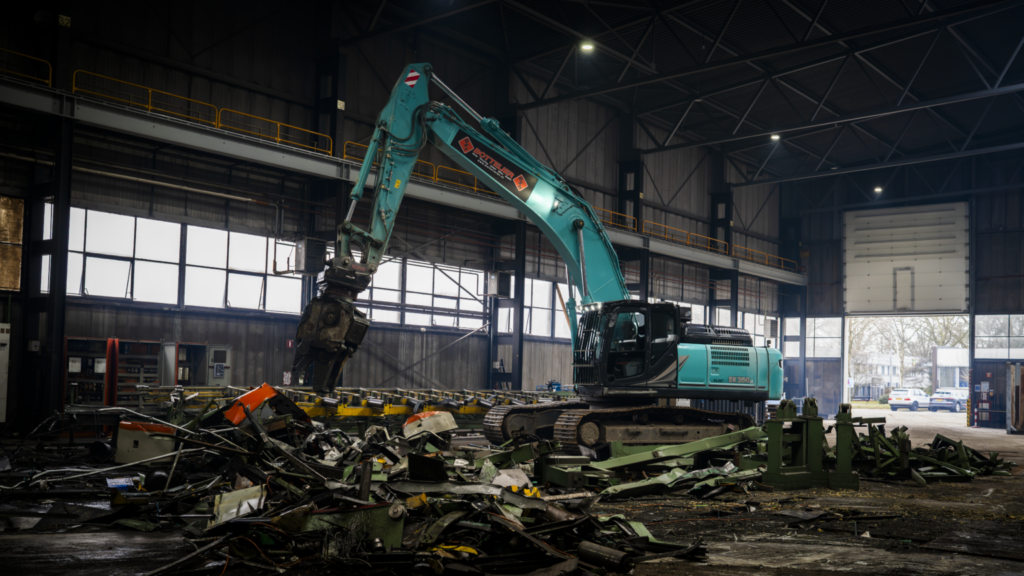
Controlled plant decommissioning offers industrial clients significant advantages in terms of safety, the environment, and project management. Instead of simply demolishing a plant, the process follows a structured plan in which risks are managed, materials are reused, and business continuity remains intact as much as possible. The questions below provide a complete picture of what controlled decommissioning entails and when it is the right choice.
What distinguishes controlled dismantling from regular demolition?
Controlled dismantling differs from regular demolition in that the process is systematic, phased, and documented. While regular demolition focuses on removing a structure as quickly as possible, controlled dismantling centers on safety, the reuse of materials, and compliance with environmental and safety legislation. Each component is deliberately disconnected, cleaned, or relocated rather than simply demolished.
In industrial installations, this distinction is even more important. Factories and process plants often contain hazardous substances such as asbestos, chromium-6, or chemical residues. A controlled approach therefore always begins with a thorough inventory and risk analysis, followed by a detailed action plan. This ensures that everyone on the shop floor knows exactly what is happening, when, and which measures are in effect.
Conventional demolition is generally suitable for simple structures without particular risks. As soon as a project involves complex installations, hazardous materials, or an active production environment, controlled dismantling is the only responsible choice.
How does a controlled factory dismantling proceed step by step?
A controlled factory dismantling proceeds in distinct phases: from preparation and remediation to dismantling, material processing, and delivering the site ready for construction. Each phase builds upon the previous one and is documented, ensuring that clients have insight into the progress and compliance with laws and regulations at every stage.
The steps in a typical dismantling project are as follows:
- Inventory and risk analysis: All hazardous substances, residues, and structural risks are mapped out.
- Advice and permit applications: Based on the inventory, the necessary permits are applied for and a plan of action is drawn up.
- Cleaning of installations: Before dismantling begins, installations are cleaned to remove hazardous residues.
- Asbestos removal and specialist remediation: Asbestos, chromium-6, and other hazardous materials are safely removed in accordance with legal procedures.
- Disassembly and dismantling: Complete production lines, equipment, and installations are systematically dismantled.
- Reuse and marketing of materials: Usable parts and materials are made available for reuse or resale.
- Soil remediation and delivery ready for construction: The site will be remediated and delivered ready for construction, documented and in accordance with the agreement.
This structured approach prevents surprises and ensures that the project is completed on schedule and within budget.
What are the safety benefits of industrial dismantling?
The safety benefits of controlled industrial decommissioning are immediate: risks are identified and managed proactively rather than reactively. By working with detailed safety plans and project-specific risk analyses, employees, the environment, and the client are protected against unexpected incidents involving hazardous substances or structural instability.
Industrial installations often still contain harmful residues after shutdown. Toxic gases, flammable liquids, or carcinogenic materials such as asbestos require specific procedures and certified specialists. A controlled approach ensures that these substances are identified and removed before more extensive decommissioning work begins.
In addition, it is possible to carry out dismantling work while adjacent production units are still in operation. This requires tight coordination and clear demarcation of work zones, but it is a real advantage for clients who do not wish to completely shut down their business process.
What environmental benefits does the circular dismantling of factories offer?
Circular dismantling of factories significantly reduces the environmental impact because materials are reused instead of being disposed of as waste. By systematically dismantling and inventorying installations and equipment, usable parts can be marketed or reused. This lowers the demand for new raw materials and limits the amount of waste sent to processing.
In industrial dismantling, circular demolition is more than a sustainability ambition. It is a measurable approach in which the reuse rate of materials is a concrete indicator of a project's environmental performance. A high reuse rate means less waste transport, lower landfill costs, and a lower CO2 footprint for the overall project.
Circular dismantling also aligns with the increasingly strict environmental legislation that industrial clients must comply with. By choosing a dismantling company with ISO 14001 certification, you know that environmental management is structurally embedded in the working method, not an afterthought.
When is a turnkey demolition partner the best choice?
A turnkey demolition partner is the best choice when a project involves multiple disciplines, such as cleaning, asbestos removal, dismantling, and soil remediation, and when the client requires a single point of contact to manage the entire process. Turnkey demolition prevents loss of coordination between different contractors and reduces the risk of delays or ambiguity regarding responsibilities.
For industrial clients with complex projects, there are even more reasons to opt for a turnkey approach:
- One contract partner is responsible for planning, execution, and delivery.
- Risks are managed centrally and not distributed across multiple parties.
- Communication is more efficient, which saves time and costs.
- The client receives a documented, construction-ready handover without remaining obligations.
Turnkey dismantling is also relevant when continuity of the production process is a strict prerequisite. An experienced partner plans the work in such a way that adjacent activities experience minimal disruption.
Which certifications must a dismantling company have?
A reliable dismantling company for industrial projects must possess at least NEN-EN-ISO 9001 for quality management, NEN-EN-ISO 14001 for environmental management, SC 530 for asbestos removal, and VCA Petrochemistry for safety in the (petro)chemical sector. These certifications are not a formality, but proof that the working method structurally complies with legal and sector-specific requirements.
Depending on the type of project, additional certifications are relevant:
- BRL SVMS-007: For working with asbestos-containing materials in accordance with applicable standards.
- SIKB 7000 protocol 7001/7004: For soil remediation and earthworks.
- CO2 Performance Ladder Level 3: Demonstrable efforts to reduce the CO2 emissions of projects.
- CSR Performance Ladder Level 3: Evidence of corporate social responsibility as an integral part of business operations.
When selecting a demolition company, always request an up-to-date certification overview. Certifications are time-bound and must be renewed regularly. A certified partner provides you, as the client, with the assurance that the project complies with all applicable laws and regulations, including during inspections by supervisory authorities.
How we help with controlled factory dismantling
We manage the entire decommissioning process for industrial clients, from initial surveying to documented delivery ready for construction. Our approach is turnkey, which means you have a single point of contact for all disciplines within the project. This includes:
- Advice, risk analysis and permit applications
- Cleaning of installations and removal of hazardous residues
- Asbestos removal and chromium-6 remediation
- Dismantling of complete production lines and equipment
- Circular processing of materials with a reuse rate of 99%
- Soil remediation and delivery ready for construction
We work with the broadest certifications in the market, including ISO 14001, NEN-EN-ISO 9001, VCA Petrochemicals, SC 530, and CSR Performance Ladder Level 3. This ensures that safety, environmental management, and quality are guaranteed at every stage of the project. Would you like to know what we can do for your decommissioning project? Please contact us for a no-obligation consultation.