
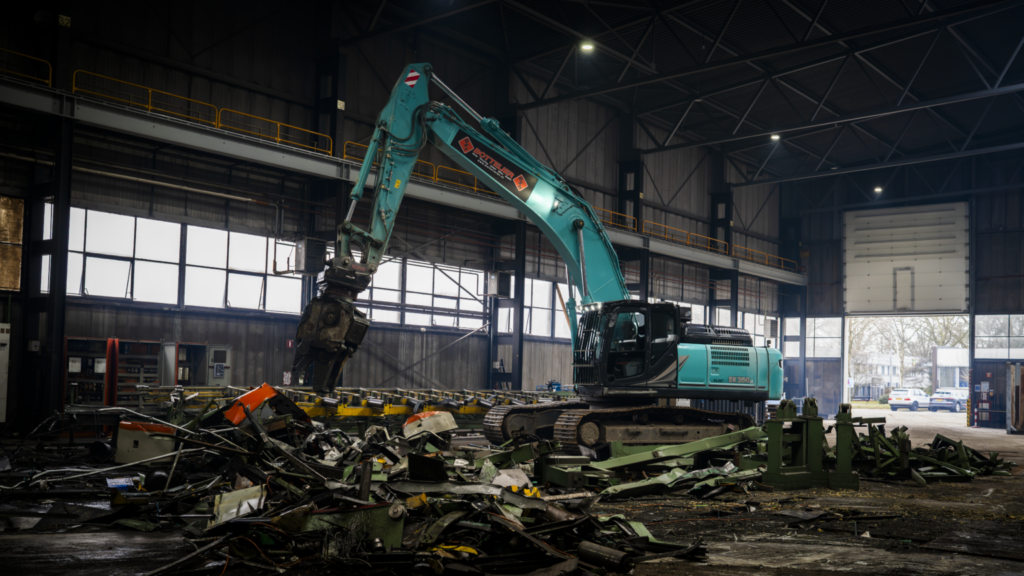
The costs of dismantling production facilities typically range from tens of thousands to several million euros, depending on the scale, complexity, and the presence of hazardous substances such as asbestos. For an average industrial project, you must take into account a wide range of cost factors that vary significantly by situation. In this article, we answer the most frequently asked questions about demolition costs in the industry.
Which factors determine the price of industrial dismantling?
The price of industrial dismantling is determined by the size and complexity of the installation, the presence of hazardous substances, the accessibility of the site, the required permits, and the desired completion time. The more specialized operations required, the higher the total costs for the dismantling of a production facility will be.
In practice, the following factors play the biggest role in determining demolition costs in the industry:
- Type of installation: A chemical reactor, blast furnace, or storage tank requires different techniques than a standard production hall.
- Presence of hazardous substances: Asbestos, chromium-6, PCBs, or chemical residues increase costs due to mandatory remediation protocols.
- Accessibility and space: Limited workspace or the need to work within an active production process requires additional planning and safety measures.
- Permit process: Complex environmental permits or environmental reports cost time and money.
- Desired completion: A tight deadline drives up costs due to extra teams or specialized equipment.
- Residual value of materials: Reusable installations or metal value can reduce net costs.
Industrial clients working with a turnkey contractor pay for the entire process, but thereby avoid hidden costs due to unexpected bottlenecks that arise more frequently with a fragmented approach.
How much does asbestos removal cost at a production facility?
Asbestos remediation at a production facility costs on average between 50 and 150 euros per square meter, but for large-scale or heavily contaminated industrial sites, the total costs can run into hundreds of thousands of euros. The exact price depends on the type of asbestos, the quantity, the bonding, and the required remediation method.
Asbestos is classified into bonded and non-bonded forms. Non-bonded asbestos, such as sprayed asbestos or loose insulation, is more hazardous and therefore more expensive to remove. Industrial objects such as chimneys, piping, boilers, and roofing sheets often contain a combination of both types, requiring a detailed inventory before a reliable cost estimate can be made.
In addition to the direct removal costs, you must also take into account:
- Mandatory asbestos survey by a certified agency (SC 540)
- Disposal and processing of asbestos waste via recognized processors
- Release measurements after remediation
- Possible temporary shielding of work areas
For production facilities that remain in use during the remediation, additional costs for process control and safety monitoring apply.
How are demolition costs calculated for a turnkey project?
In a turnkey demolition assignment, demolition costs are calculated based on the total project scope: from survey and permit application up to and including the documented delivery of the site ready for construction. The contractor combines all sub-processes and charges a total price that includes risks and coordination costs.
A turnkey calculation always begins with a thorough site inspection and a risk analysis. Based on this, the contractor draws up a plan of action with a detailed budget. The cost items included are:
- Project management and engineering
- Permit applications and environmental reports
- Cleaning and disconnection of installations
- Asbestos remediation and removal of hazardous substances
- Dismantling and demolition of structures
- Disposal, sorting, and processing of released materials
- Soil remediation if necessary
- Final delivery and documentation
The advantage of a turnkey approach is that, as the client, you work with a single point of contact and a single fixed price. This provides budget certainty and prevents subcontractors from shifting costs onto one another. Consequently, this model is the most common working method for complex industrial decommissioning projects .
What is the cost difference between demolition and circular demolition?
Traditional demolition is generally cheaper in the short term, but circular demolition yields a higher residual value through selective dismantling and the reuse of materials. The initial costs of circular demolition are higher due to the more labor-intensive approach, but the net costs are often lower due to revenues from reusable installations and raw materials.
In traditional demolition, materials are removed and disposed of as quickly as possible, with a focus on speed and volume. In circular demolition, installations, structural components, and materials are carefully dismantled so they can be reused. This requires more time and planning, but also yields greater returns:
- Reusable installations and machines can be marketed or relocated
- Metals and other raw materials are sorted and sold
- Less waste processing means lower landfill costs
- Sustainability gains count towards CSR reports and CO2 reduction targets
For industrial clients dealing with valuable installations or aiming for sustainability goals, circular demolition is the wiser choice, both financially and strategically. A reuse rate of 99% is not an exception, but an achievable goal in a well-organized demolition project.
When is a specialized demolition contractor more cost-effective than a general contractor?
A specialized demolition contractor is more cost-effective than a general contractor when a project involves hazardous materials, complex installations, or strict environmental requirements. Specialists possess the right certifications, techniques, and experience to execute these types of projects without costly delays or rework.
General contractors can outsource industrial demolition work to subcontractors, which complicates coordination and increases the risk of miscommunication. A specialized demolition contractor has all the necessary expertise in-house: from asbestos removal and chemical cleaning to the dismantling of process installations and soil remediation. This avoids the following cost pitfalls:
- Unexpected additional costs due to missing certifications among subcontractors
- Delays due to incorrect permit applications
- Fines or remedial work due to non-compliance with environmental legislation
- Higher insurance costs due to inexperienced execution of complex risks
In addition, a specialist has access to specialized equipment that a general contractor must rent, which lowers daily rates. For projects in the (petro)chemical, energy, or heavy manufacturing industries, a specialized partner is therefore structurally cheaper over the entire project duration.
How Bottelier helps with the dismantling of your production facility
As a specialized demolition contractor, we offer a complete turnkey process for the dismantling of production facilities, in which we provide insight into all cost factors in advance. Our approach includes:
- Thorough site inspection and risk analysis beforehand
- Handling permit applications and environmental reports
- Asbestos removal, cleaning and dismantling of complex installations
- Circular demolition with a reuse rate of 99%
- Soil remediation and documented handover of the site
- One point of contact for the entire project, from advice to delivery
We work with certified methods, including ISO 14001, NEN-EN-ISO 9001, SC 530, and VCA Petrochemie, ensuring that you, as the client, can be certain the project complies with all legal requirements. Would you like to know the cost of dismantling your production facility? Contact us for a no-obligation consultation.