
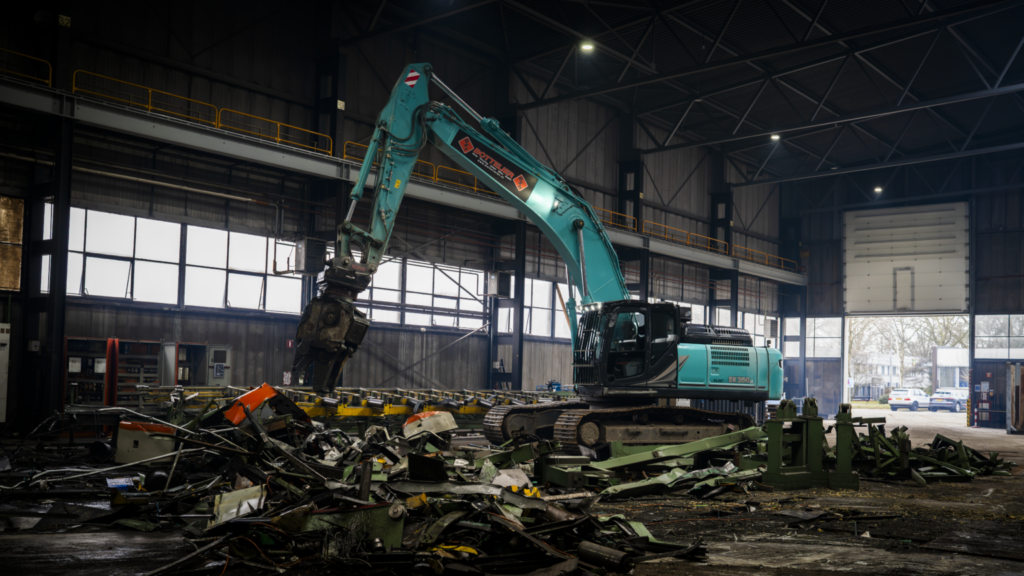
In the Netherlands, multiple legal frameworks and technical standards apply to the safe dismantling of production facilities, which together determine how a dismantling project may be carried out. Examples include the Working Conditions Act, the Building Decree, European Machinery Directives, and specific certification requirements for demolition companies. Exactly which standards apply depends on the type of installation, the presence of hazardous substances, and the sector. In this article, we answer the most frequently asked questions about dismantling standards in the industry.
Which laws and regulations apply to industrial dismantling?
Industrial dismantling in the Netherlands is subject to a combination of national and European laws and regulations. The main frameworks are the Working Conditions Act (Arbowet), the Building Decree 2012, the Environmental Management Act, and the ATEX Directive for explosive environments. Together, they set requirements for safety, environmental management, and the qualifications of executing parties.
Moreover, sector-specific rules apply to industrial projects in the (petro)chemical, energy, or heavy manufacturing industries. The Working Conditions Act (Arbowet) requires clients and contractors to draw up a thorough risk inventory and evaluation (RI&E) before work commences. The Building Decree (Bouwbesluit) regulates, among other things, the notification obligation for demolition work and the requirements regarding safety plans.
In addition, the Environment and Planning Act plays an increasingly important role. Since its entry into force in 2024, this act bundles permits and notifications regarding spatial interventions, including the demolition and dismantling of large industrial objects. Timely application for the correct permits is therefore an important part of every dismantling project.
Which certifications must a demolition contractor have?
A demolition contractor dismantling industrial production facilities must possess a number of mandatory and recommended certifications. The minimum requirements depend on the type of work, but for large-scale industrial dismantling, VCA Petrochemie, the Asbestos Removal Process Certificate (SC 530), and BRL SVMS-007 are the most relevant certificates.
In addition to these basic requirements, supplementary quality and environmental certifications are a strong indicator of craftsmanship and reliability. Consider:
- NEN-EN-ISO 9001 for quality management systems
- NEN-EN-ISO 14001 for environmental management systems
- CO2 Performance Ladder level 3 for CO2 reduction and transparency
- CSR Performance Ladder Level 3 for Corporate Social Responsibility
- SIKB 7000 protocol 7001/7004 for soil remediation
For clients in the industry, verifying certifications is not only a formal step but also a practical way to assess whether a contractor takes safety and environmental standards seriously. A contractor with a broad certification portfolio demonstrates that they are systematically working on quality assurance and compliance with laws and regulations.
How does a safe dismantling proceed step by step?
The safe dismantling of a production facility always follows a structured approach. The steps begin long before the first wrecking hammer falls and only end with the documented handover of the site. A phased approach reduces risks, prevents downtime, and ensures compliance with all applicable standards.
The most important steps in a safe dismantling process are:
- Inventory and risk analysis: Mapping of hazardous substances, structural risks, and environmental factors.
- Action plan and safety plan: Drafting a project-specific safety plan and a detailed work plan.
- Permit applications: Applying for all necessary demolition and environmental permits from the competent authorities.
- Cleaning and decontamination: Removal of hazardous residues from installations before dismantling begins.
- Asbestos remediation: If present, removal of asbestos by certified specialists.
- Dismantling and demolition: Controlled dismantling of installations, structures, and buildings.
- Material separation and reuse: Sorting released materials for reuse, recycling, or responsible disposal.
- Documented delivery: Transfer of the site with full documentation of completed works.
In industrial decommissioning projects, the cleaning phase is particularly important. After shutting down a plant, harmful residues may remain in pipes, tanks, and reactor vessels. Safely removing these requires specific procedures and protective equipment.
What are the specific standards for asbestos during demolition?
During the dismantling of production facilities built before 1994, the presence of asbestos is a serious concern. The standards for asbestos removal are laid down in the Working Conditions Decree and elaborated in the Asbestos Removal Process Certificate (SC 530). Only certified companies are permitted to carry out risk class 2 and 3 asbestos work.
Before dismantling work begins, an asbestos survey by a certified agency is mandatory. This report classifies the asbestos materials found according to risk class and indicates which remediation method is required. The three risk classes determine the level of protection for employees and the necessary containment measures.
Following the asbestos remediation, a final measurement by an independent laboratory always takes place. The remediated area may only be released when air concentrations are below the statutory limits. The complete documentation of the remediation, including the final measurement report, is part of the handover to the client.
How are dismantling and production continuity combined?
Dismantling and production continuity can be combined by carefully planning the work in phases around the ongoing production process. This requires detailed coordination between the dismantling contractor and the client regarding working hours, safety zones, access routes, and communication procedures.
In practice, this means that dismantling work is often carried out in delimited zones, while adjacent production units continue operating as usual. Additional measures are required for this, such as:
- Establishing physical barriers and safety zones
- Coordination of activities involving hazardous substances during off-peak hours
- Clear communication protocols between project team and production management
- Continuous monitoring of air quality and noise levels in the vicinity of active installations
This type of work places high demands on the contractor's expertise. Knowledge of industrial processes, safety protocols for active environments, and experience with complex logistics are prerequisites to prevent production disruption.
What are the sustainability standards for demolition material and reuse?
For demolition material from industrial dismantling, both statutory minimum standards and voluntary sustainability standards apply. The Building Materials Decree and the Environmental Management Act set requirements for the separation, registration, and processing of released materials. Hazardous waste must be collected separately and disposed of via recognized processors.
In addition to statutory obligations, an increasing number of industrial clients are opting for contractors who actively prioritize reuse and circular demolition. This involves collecting materials separately as much as possible and offering them for reuse or high-quality recycling, rather than incineration or landfill. The CO2 Performance Ladder offers a measurable framework for contractors to report and reduce their CO2 emissions, including in the demolition material processing chain.
The percentage of reuse of released materials is therefore a concrete measure of the sustainability performance of a dismantling project. The higher this percentage, the less material ends up as waste and the smaller the ecological footprint of the project.
How we help with the safe dismantling of production facilities
We offer industrial clients a complete turnkey decommissioning process, in which all standards for the safe decommissioning of production facilities are ensured in every project component. From the initial survey to the documented handover, we handle the entire process. In concrete terms, this means:
- Customized advisory plans, safety plans, and risk analyses per project
- Certified asbestos removal and cleaning of complex industrial installations
- Dismantling at active production environments without disruption of business processes
- Reuse rate of 99% thanks to our circular demolition method
- Full permit guidance and documented project delivery
- Broad certification portfolio: VCA Petrochemicals, ISO 9001, ISO 14001, SC 530, CSR Performance Ladder level 3 and more
Would you like to know how we can execute your decommissioning project safely, compliantly, and sustainably? Contact us and we will discuss the possibilities.