
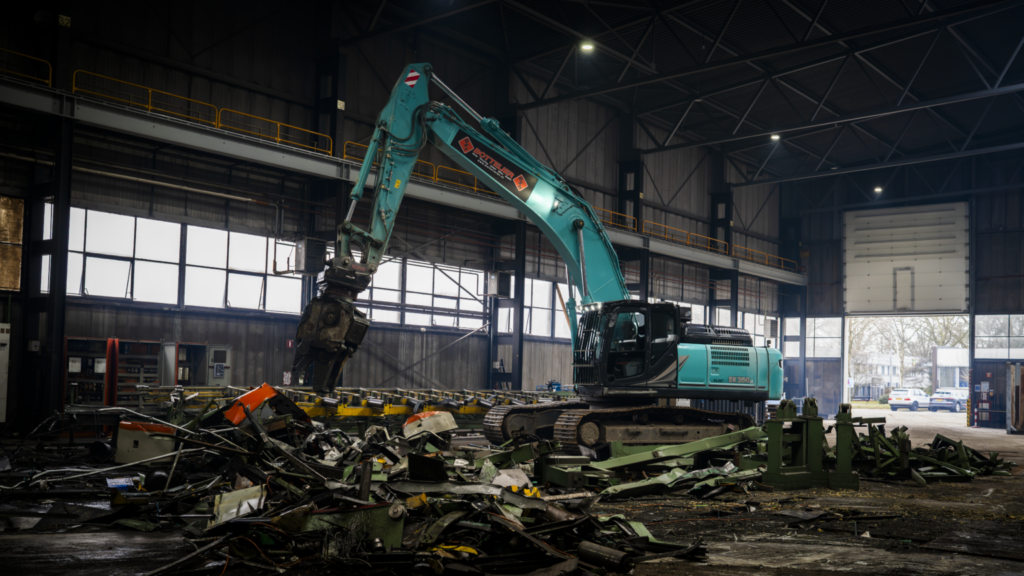
The dismantling of production facilities is the controlled decommissioning, dismantling, and removal of industrial installations, production lines, buildings, or entire factories. It encompasses much more than just demolition: cleaning, asbestos remediation, equipment dismantling, and preparing the site for construction are all part of the process. In this article, we answer the most frequently asked questions about industrial dismantling, from the steps in the process to costs and certifications.
Which activities fall under the dismantling of production facilities?
The dismantling of production facilities encompasses all activities required to safely and completely decommission an industrial asset. This begins with cleaning and remediation, continues through the dismantling of installations, and ends with delivering the site ready for demolition or construction. It is an integrated process in which safety, environmental legislation, and the reuse of materials are central.
Specifically, the following activities fall under industrial dismantling:
- Cleaning of installations after shutdown, to remove harmful residues
- Asbestos removal and chromium-6 remediation
- Dismantling of production lines, reactor vessels, piping and other equipment
- Demolition work on buildings, foundations, and structures
- Soil remediation at contaminated sites
- Sorting, reuse and disposal of released materials
- Documented handover of the site
The cleaning of installations deserves special attention. After shutting down an industrial installation, toxic or hazardous residues may remain in pipes, tanks, and vessels. Without the proper procedures, these substances pose a risk to employees and the environment. The actual dismantling can only begin once the installation has been safely cleaned.
What is the difference between demolition, dismantling, and removal?
Demolition, dismantling, and removal are often used interchangeably, but they describe different approaches. Demolition is the destructive removal of an object or structure. Dismantling is the careful taking apart of installations or components with a view to reuse or relocation. Removal is the umbrella term for the complete removal of an object, including all associated work.
All three stages occur in the industrial dismantling of a factory or production facility. Valuable equipment is dismantled so that it can be reused or sold elsewhere. Building structures that have no reuse value are demolished. The entire project, from initial inventory to the completed site, is called 'amoovering'.
The distinction is practically relevant: dismantling requires different planning, different tools, and different expertise than demolition. A dismantling company that masters both can choose the most efficient and sustainable method for each component.
How does a dismantling project proceed step by step?
A production facility dismantling project proceeds in fixed phases: from inventory and permit applications to the documented handover of the site. The exact lead time and content vary per project, but the underlying structure is virtually the same for every industrial dismantling project.
The steps are generally as follows:
- Inventory and advice: Mapping of the installations, hazardous substances, structures, and the condition of the site.
- Action plan: Drafting a customized safety plan, risk analysis, and decommissioning plan.
- Permit applications: Applying for the necessary environmental and demolition permits and notifications to the competent authorities.
- Cleaning and remediation: Removal of hazardous substances such as asbestos, chromium-6, and chemical residues.
- Dismantling: Carefully disassembling installations, production lines, and equipment.
- Demolition works: Removal of buildings, structures, and foundations.
- Disposal and reuse: Sorting and processing of released materials, maximally focused on reuse.
- Soil remediation: If applicable, remediation of contaminated soil.
- Documented delivery: Delivery of the site with complete documentation.
In production environments, planning is particularly complex. Work must be scheduled in such a way that the ongoing business process is not disrupted. This requires close coordination between the decommissioning contractor and the client throughout the entire project.
When is circular demolition the right choice?
Circular demolition is the right choice when a production facility contains released materials and installations suitable for reuse, and when the client wishes to minimize the environmental impact of the dismantling. In practice, this is relevant to virtually every industrial demolition project, as steel, concrete, and equipment can represent a significant residual value.
In circular demolition, materials are not simply disposed of to a processing plant. Instead, they are sorted, assessed for reuse value, and, where possible, directly used in new applications. Installations and machines that are still functional are dismantled and marketed. This prevents scrapping and reduces the project's carbon footprint.
Legislation and regulations are increasing pressure on circular processing. Clients in the industry working with ISO 14001-certified partners or who have their own sustainability goals are increasingly consciously choosing a dismantling contractor capable of achieving a high reuse rate.
Which certifications must a dismantling company have?
A dismantling company active in the industry must possess at least a process certificate for asbestos removal (SC 530), VCA certification, and a quality management system in accordance with NEN-EN-ISO 9001. For work in the petrochemical industry or involving hazardous substances, additional certifications are required, such as VCA Petrochemicals and SVMS-007.
The following certifications are relevant when selecting an industrial dismantling company:
- SC 530: Process certificate for asbestos removal, legally required for asbestos remediation
- NEN-EN-ISO 9001: Quality management system
- NEN-EN-ISO 14001: Environmental management system
- VCA Petrochemicals: Safety certification for work in the petrochemical industry
- BRL SVMS-007: Assessment guideline for demolition works
- CO2 Performance Ladder: Insight into and reduction of CO2 emissions
- CSR Performance Ladder: Demonstrable Corporate Social Responsibility
- SIKB 7000 (protocol 7001/7004): Relevant to soil remediation
The more certifications a dismantling company holds, the more versatile it is. For complex projects where multiple disciplines converge, such as asbestos removal combined with soil remediation and the dismantling of process installations, a fully certified contractor is a prerequisite for executing the project as a single entity.
What determines the costs of industrial dismantling?
The costs of industrial dismantling are determined by the size and complexity of the installations, the presence of hazardous substances, the accessibility of the site, the desired completion time, and the reuse rate of the released materials. There is no fixed price per project, as every dismantling project is unique.
The main cost factors are:
- Scope of the installations: More material and larger structures mean more labor and more waste.
- Hazardous substances: Asbestos, chromium-6, and chemical residues require specialized remediation, which increases costs.
- Accessibility and location factors: Limited space or an active production process on the site requires additional planning and safety measures.
- Permits: Complex permit processes take time and can extend the processing time.
- Reuse of materials: Released steel, equipment, or construction materials with reuse value can reduce net project costs.
- Project scope: A turnkey assignment including soil remediation and delivery ready for construction requires more than just demolition work.
A detailed preliminary inventory is the most reliable way to arrive at a realistic cost estimate. The more information available regarding the condition of the installations and the presence of hazardous substances, the more accurate the quotation.
How Bottelier helps with the dismantling of production facilities
We manage the entire decommissioning process for industrial clients, from the initial survey to the documented handover of the site. Our approach is turnkey: a single point of contact, one responsible party for all disciplines.
What we specifically offer:
- Tailored advice, action plan, and risk analysis for your project
- Cleaning and remediation of installations, including asbestos and chromium-6 remediation
- Dismantling of production lines, process plants and other equipment
- Reuse and marketing of released installations and materials
- Demolition works and soil remediation
- Construction-ready delivery with full documentation
- Execution in production environments, without disruption to the business process
We are one of the most extensively certified dismantling companies in the Netherlands, holding, among others, VCA Petrochemie, ISO 14001, NEN-EN-ISO 9001, SC 530, and CSR Performance Ladder Level 3. Our reuse rate of 99% demonstrates that sustainability is not an afterthought for us. Would you like to know what we can do for your project? Contact us for a no-obligation consultation.