
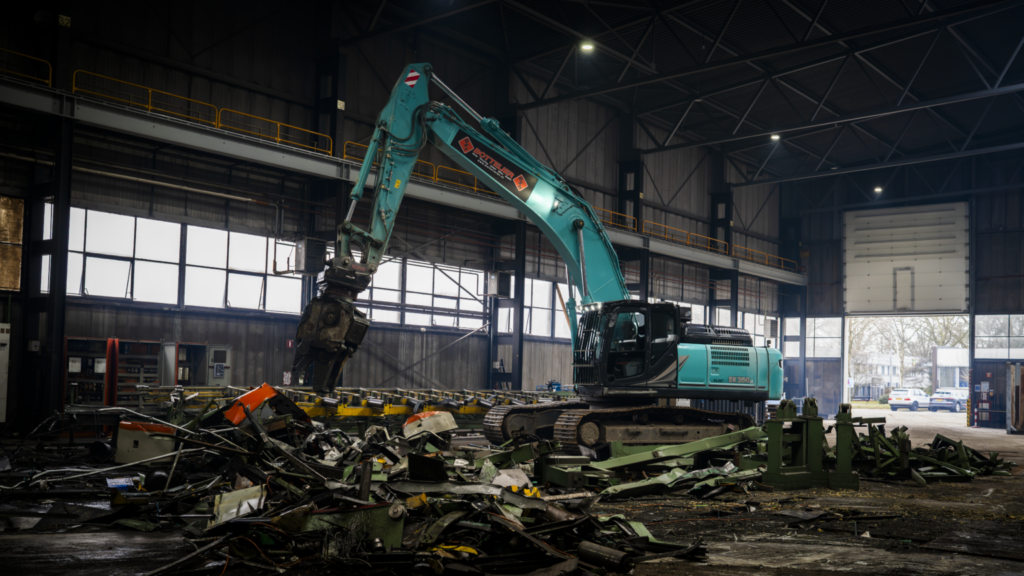
Demolition and factory dismantling are two different approaches to removing industrial objects. With demolition, a building or installation is completely taken down, with the materials being recycled or disposed of. With dismantling, components are carefully disassembled with the aim of reuse or relocation. The choice between the two methods depends on the condition of the installation, the reusability of materials, and the client's objective. In this article, we answer the most frequently asked questions about industrial demolition and dismantling.
When is demolition chosen instead of dismantling?
The decision to demolish a factory or industrial installation is made when the structure no longer has reusable value, the technical condition is too poor for dismantling, or when the planning and costs of careful dismantling do not outweigh the revenue. Demolition is the most direct route to a site ready for construction.
In practice, industrial clients opt for demolition in the following cases:
- Obsolete buildings or installations where components have been technically written off
- Situations where the lead time must be as short as possible
- Structures containing hazardous substances such as asbestos, where dismantling poses an additional risk
- Projects where the site must be delivered fully ready for construction
Dismantling is actually the better choice when machines, production lines, or installations are still functional and can be reused or sold. This saves costs and reduces the environmental impact. Both methods can also be combined: demolishing a factory where valuable components are first dismantled is a widely used approach in industrial practice.
Which techniques are used in industrial demolition?
In the industrial demolition of factories, various techniques are employed depending on the type of structure, the environment, and safety requirements. The most commonly used methods are mechanical demolition with heavy equipment, controlled implosion, and phased demolition, in which parts of an installation are removed step by step.
For complex industrial environments, such as active production sites or installations in the (petro)chemical industry, additional techniques are important:
- Phased demolition: components are removed in a predetermined order to ensure the stability of surrounding structures.
- Asbestos remediation prior to demolition: at older factories, asbestos is a common risk that must first be safely removed.
- High-reach demolition: specialized equipment is deployed for chimneys, silos, and towers.
- Selective demolition: where reusable materials are separated from waste to maximize recycling
Safety is always paramount in industrial demolition. Work on installations in production requires precise planning and coordination so that the ongoing business process is not disrupted.
How does a professional factory dismantling proceed?
The professional dismantling of a factory proceeds in phases: from inventory and cleaning to dismantling, reuse, and soil remediation. Each phase requires specific expertise and certifications. The entire process is typically offered on a turnkey basis, so that the client has a single point of contact.
The steps in an industrial dismantling project are:
- Inventory and advice: mapping the installation, substances present, and reusable components.
- Permit applications: arranging the necessary environmental permits and notifications
- Cleaning: after the shutdown of an installation, harmful residues may remain; these are safely removed before dismantling begins.
- Asbestos and chromium-6 remediation: where applicable, hazardous substances are remediated in accordance with statutory protocols.
- Dismantling: the systematic dismantling of machines, production lines, and structures
- Reuse and marketing: usable parts are made available, sold, or moved.
- Soil remediation and delivery ready for construction: the site is being prepared for its next purpose.
Thorough preparation, including a tailor-made advisory plan, safety plan, and risk analysis, is crucial for the success of the project.
What happens to the materials after demolition or dismantling?
After the demolition or dismantling of a factory, materials are reused or recycled as much as possible. Steel, concrete, copper, and other metals are sorted and offered to processing companies. During dismantling, complete installations or machines are directly reused or sold. A responsible demolition company strives for the highest possible reuse rate.
In the industrial demolition sector, circular demolition is considered the most sustainable approach. This entails that materials are preferably given a second life rather than being destroyed. The benefits of this are:
- Less waste and lower landfill costs
- Value creation from reusable parts and materials
- A lower CO2 footprint of the total project
- Compliance with increasingly strict environmental legislation regarding waste processing
Strict statutory processing rules apply to hazardous materials such as asbestos, chromium-6, or chemical residues. These substances may only be processed by certified companies with the proper protocols and disposal documentation.
Which certifications are required for the demolition and dismantling of factories?
For the demolition or dismantling of industrial plants, several certifications are legally required or strongly recommended. The most important are SC 530 for demolition work, the Asbestos Removal Process Certificate (BRL SVMS-007), and VCA Petrochemistry for work in hazardous environments. Additional certifications such as ISO 14001 and NEN-EN-ISO 9001 demonstrate that a company operates in accordance with recognized quality and environmental standards.
An overview of relevant certifications for industrial demolition and dismantling:
- SC 530: legally required for carrying out demolition work in the Netherlands
- BRL SVMS-007: mandatory for asbestos removal
- VCA Petrochemicals: required for work in the petrochemical industry
- NEN-EN-ISO 9001: Quality management system for reliable project execution
- ISO 14001: environmental management system that ensures demonstrably environmentally conscious working practices
- SIKB 7000 (protocol 7001/7004): relevant for soil remediation after demolition or dismantling
- CSR Performance Ladder Level 3: Demonstrable Corporate Social Responsibility
For clients in the industry, verifying these certifications is an important step in selecting a demolition or dismantling partner. Missing certifications can lead to legal risks, fines, or project delays.
How Bottelier helps with the demolition and dismantling of factories
We offer industrial clients a complete turnkey process for both the demolition and dismantling of factories and installations. From the initial survey to the documented, construction-ready handover of the site. This is what you can expect from us:
- Tailor-made advisory plan, safety plan, and risk analysis for every project
- Execution at installations in production, without disruption of the business process
- Complete asbestos removal, chromium-6 remediation, and soil remediation in-house
- A reuse rate of 99% thanks to our circular approach
- Broad certification, including SC 530, BRL SVMS-007, ISO 14001, NEN-EN-ISO 9001 and VCA Petrochemicals
- Working in the chemical, petrochemical, pharmaceutical, food, and energy sectors
Would you like to know what we can do for your project? Contact us and we will discuss the possibilities.