
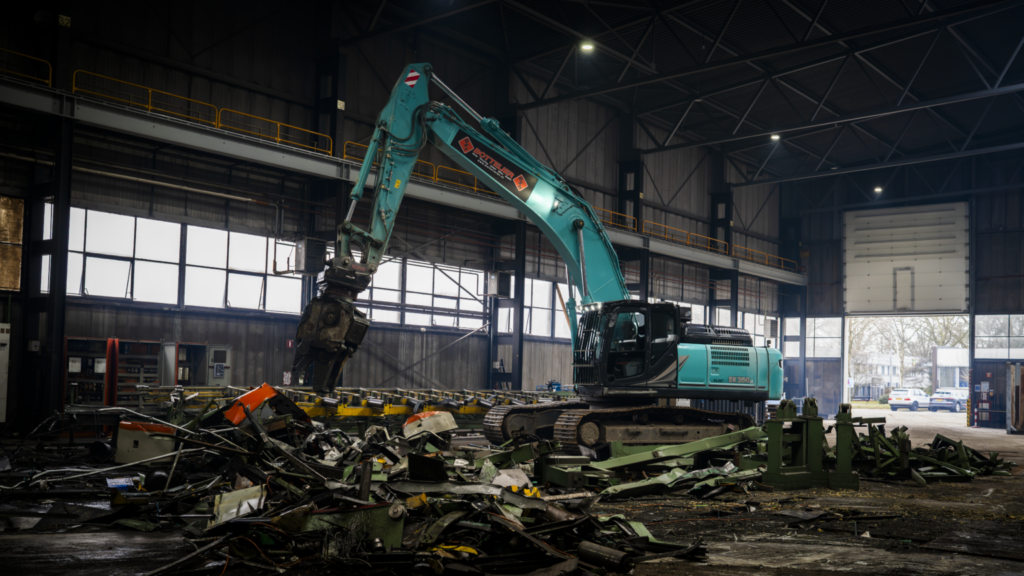
Safety during factory dismantling is so important because the risks to people, the environment, and the surroundings in industrial demolition projects are significantly greater than in conventional construction demolition. Hazardous substances, unstable structures, and complex installations make every error potentially serious. This is especially true for industrial environments where chemical, mechanical, and structural hazards are present simultaneously. In this article, we answer the most frequently asked questions about demolition safety in the industry.
What risks are specific to industrial plant dismantling?
Industrial plant dismantling involves risks that are fundamentally different from those of regular demolition projects. Hazardous residues in pipes and tanks, unstable high-rise structures, the presence of asbestos or chromium-6, and the combination of mechanical and chemical hazards make plant dismantling one of the most high-risk activities in the construction sector.
The specific risks associated with industrial dismantling include:
- Hazardous substances: After shutting down an installation, harmful and toxic residues may remain in pipes, reactors, or storage tanks. Examples include flammable liquids, toxic gases, or radioactive materials.
- Asbestos and chromium-6: Many older industrial buildings and installations contain asbestos or chromium-6-containing coatings. Improper handling of these poses a direct health risk to workers and local residents.
- Structural instability: Factory buildings and installations are often designed as a cohesive whole. Partial dismantling can unexpectedly compromise the load-bearing capacity of remaining structures.
- Height and space risks: Chimneys, reactor towers, and blast furnaces require work at great heights in combination with heavy equipment.
- Explosion hazard: In the petrochemical and process industries, residues in installations can form flammable or explosive mixtures.
How are safety risks identified during factory dismantling?
Safety risks during plant dismantling are identified through a structured risk analysis prior to the project. This includes an inventory of hazardous substances, an assessment of the structural condition of the facility, and the development of a project-specific safety plan covering all work phases.
A thorough risk assessment begins with the collection of technical documentation: construction drawings, as-built drawings, process diagrams, and historical data on materials used. Based on this, specialists draw up a plan of action that takes into account the specific circumstances of the project.
Concrete steps in this process are:
- Inventory and investigation of hazardous substances, including asbestos, chromium-6, and chemical residues
- Structural inspection of the object to be dismantled
- Drafting a detailed safety plan and work procedures per phase
- Coordination with the client, the environmental agency, and any adjacent business activities
- Briefings and toolbox meetings with the executive team
For industrial decommissioning projects, tailor-made advisory plans and risk analyses are drawn up for each project, tailored to the specific sector and type of installation.
What laws and regulations apply to safety during factory dismantling?
Multiple statutory frameworks apply simultaneously to safety during factory dismantling. The most important are the Working Conditions Act (Arbowet), the Asbestos Removal Decree, the Environmental Management Act, and the Environment and Planning Act. In addition, sector-specific standards apply, depending on the nature of the installation and the substances present.
The Working Conditions Act (Arbowet) obliges employers to identify and manage risks to employees. A separate legal regime applies to asbestos: asbestos removal may only be carried out by certified companies holding an asbestos removal process certificate (SC 530). For decommissioning in the petrochemical industry, additional requirements apply under the VCA Petrochemistry standard.
Relevant laws and regulations at an overview:
- Working Conditions Act and Working Conditions Decree: Mandatory risk assessment and safe working conditions
- SC 530 / Asbestos Removal Process Certificate: Statutory requirement for asbestos remediation
- Environment and Planning Act: Permit requirement for demolition work above certain thresholds
- Environmental Management Act: Rules for waste processing and emissions
- REACH Regulation (EU): Management of hazardous chemicals in waste streams
Which certifications guarantee safe working practices in industrial demolition?
Certifications that guarantee safe working practices in industrial demolition include VCA Petrochemie, SC 530 for asbestos removal, NEN-EN-ISO 9001, NEN-EN-ISO 14001, and BRL SVMS-007. Together, these standards cover safety management, environmental management, quality assurance, and specific high-risk activities such as asbestos remediation.
Each certification has its own focus:
- VCA Petrochemicals: Safety standard specific to activities in the petrochemical industry, with high requirements for safety management and personal protective equipment.
- SC 530 / Asbestos Removal Process Certificate: Mandatory certification for the removal of asbestos-containing materials
- NEN-EN-ISO 9001: Quality management system that requires demonstrable control of processes
- NEN-EN-ISO 14001: Environmental management system that ensures structural attention to environmental risks
- BRL SVMS-007: Demolition safety management specific to the demolition sector
- CSR Performance Ladder Level 3: Demonstrable corporate social responsibility, including safety and sustainability
When selecting a demolition partner for industrial dismantling, it is wise to check whether all these certifications are present. A broadly certified contractor demonstrates that safety is structurally embedded in business operations, not merely on paper.
How does safe dismantling proceed at an operational factory?
Safe dismantling at an operational factory requires a strict separation between the dismantling zone and the active production environment. This calls for detailed phasing, clear demarcation procedures, continuous communication with the client, and adapted working methods that do not disrupt the ongoing production process.
This type of project places the highest demands on planning and coordination. The dismantling is divided into phases aligned with the plant's operational calendar. Specific safety measures are taken for each phase, such as shutting off pipelines, installing physical barriers, and establishing permit-required work via a permit-to-work system.
Points to consider during decommissioning in an active environment:
- Daily coordination with the production department regarding activities and risk areas
- Strict adherence to lock-out/tag-out procedures when disconnecting installations
- Use of dust-proof and noise-reducing measures to avoid burdening the working environment
- Deployment of certified employees with knowledge of the specific process risks in that industry
- Direct reporting lines for incidents or unexpected findings
What are the consequences of insufficient safety during factory dismantling?
Insufficient safety during factory dismantling can lead to serious industrial accidents, exposure of workers to hazardous substances, environmental pollution, legal liability, and significant financial damage. In the worst case, the consequences are irreversible for people and the immediate surroundings.
The direct consequences for employees are the most visible: injuries from collapses, poisoning from released substances, or long-term damage from exposure to asbestos or chromium-6. However, the indirect consequences are also far-reaching. An accident leads to work stoppages, legal proceedings, reputational damage for the client, and possible suspension of the project by the Inspectorate SZW.
For clients, the business risks are also significant:
- Fines and sanctions for violations of the Working Conditions Act or the Asbestos Removal Decree
- Liability for damage to third parties or the environment
- Project delay and associated additional costs
- Loss of permits or authorization for future projects
Investing in safety during demolition is therefore not a choice, but a business necessity. A partner with the right certifications and demonstrable experience structurally limits these risks.
How we ensure safety during factory dismantling
We offer a fully integrated approach to safe plant decommissioning, from the initial risk analysis to documented delivery. Our approach is concrete and project-specific:
- Tailor-made safety plans and risk analyses per project and sector
- Certified execution in accordance with VCA Petrochemistry, SC 530, ISO 9001, ISO 14001 and BRL SVMS-007
- Cleaning and removal of hazardous residues prior to dismantling
- Possibility of dismantling at operational installations without disrupting the production process
- Reuse rate of 99%, minimizing environmental risks during waste processing
- Turnkey execution from advice and permit applications to delivery ready for construction
Would you like to know how we can execute your dismantling project safely and efficiently? Contact us for a no-obligation consultation.