
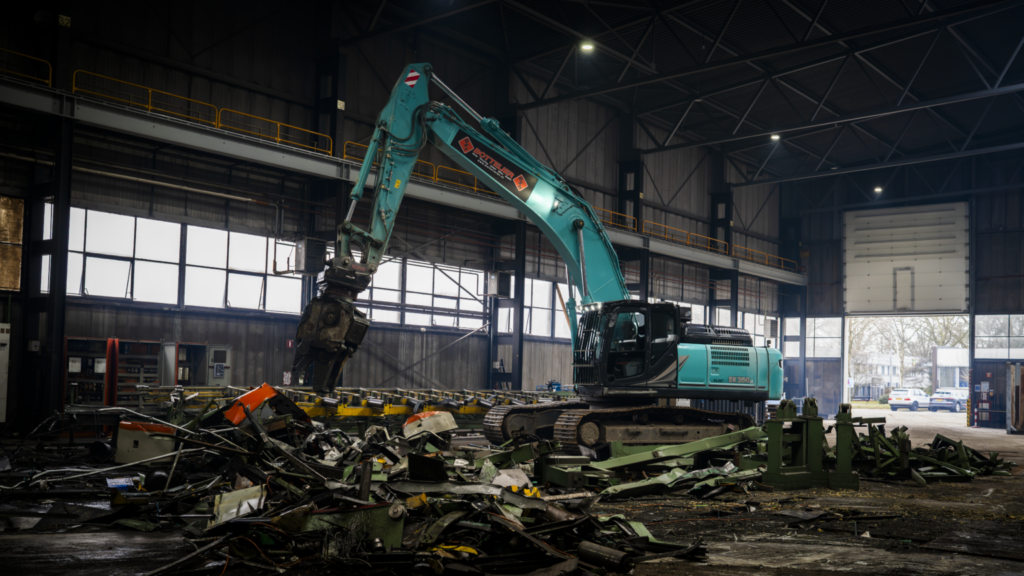
For an industrial decommissioning project, you must account for a preparation time of at least six months, and for complex projects involving hazardous substances such as asbestos, easily twelve months or more. The lead time is determined by legal obligations, permitting procedures, and technical preparation that cannot be skipped. Below, we answer the most frequently asked questions about decommissioning planning so that you know exactly what to take into account.
Which phases determine the lead time of a decommissioning project?
The lead time of a decommissioning project is determined by four consecutive phases: the inventory and risk analysis, the permit application, the technical preparation, and the actual execution. Each phase has its own minimum duration and cannot simply be skipped or shortened without the risk of delays or legal problems.
For an industrial dismantling project, planning always begins with a thorough inventory. During this phase, you map the condition of the installations, identify hazardous substances, and draw up a plan of action. This is not a formality: the outcomes of this phase directly determine which permits are required and how long the preparation takes.
Following the inventory phase comes the permitting phase, which can take two to six months depending on the project. Next is the technical preparation: drawing up safety plans, scheduling specialized subcontractors, and arranging the removal of materials. Only then does the execution itself begin. Anyone who underestimates these phases will almost certainly face delays.
How long does a permit application for demolition work take?
A permit application for demolition work takes an average of two to six months, depending on the size of the project, the location, and the authorities involved. For large industrial projects requiring multiple permits simultaneously, such as an environmental permit and a planning permit, this can extend to eight months or longer.
The municipality usually processes a standard demolition notification within four weeks, but for larger projects, the extensive procedure under the Environment and Planning Act applies. This entails longer processing times and often involves a formal public consultation round. Always count on the longer procedure for complex industrial sites.
It is also important that you can only submit the permit application after the asbestos survey has been completed. This means that you must take this step early in the planning. Anyone who submits the permit application too late will not be able to start the execution, regardless of how well the rest of the preparation is arranged.
When must an asbestos survey be carried out?
An asbestos survey must be carried out before submitting a demolition notification or permit application. This is legally required for buildings and installations constructed or installed before 1994. The survey must be performed by a certified company holding the asbestos survey process certificate.
In practice, this means that you must schedule the asbestos survey early in the planning process, preferably four to eight weeks before you intend to submit the permit application. The turnaround time for the survey itself varies from a few days to several weeks, depending on the size and accessibility of the site.
If asbestos is found, a remediation plan follows, which must also be carried out by a certified company. The remediation itself requires additional time and must be completed before the actual demolition work begins. In the event of a positive asbestos finding, count on an additional time investment of two to six months in the planning.
What happens if you plan a decommissioning project too late?
If you plan a decommissioning project too late, you run the risk of significant delays, higher costs, and legal problems. Permits that are not applied for on time block the start of execution. Missing inventories or remediation reports can lead to the work being halted by supervisors.
In the industry, a delay in demolition planning has direct consequences for subsequent projects, such as new construction, renovation, or site redevelopment. Contractual deadlines are then missed, which can lead to fines or damage claims.
In addition to the financial consequences, there are also safety risks. When a dismantling project is carried out under time pressure, the likelihood of skipping safety protocols increases. This is unacceptable, particularly for industrial installations containing hazardous residues. A well-planned dismantling protects not only the schedule but also the people performing the work.
How much time should you set aside for an industrial demolition project?
As a rule of thumb, for an industrial demolition project, you should reserve at least six to twelve months of preparation time, excluding the actual execution. For large or complex projects involving multiple hazardous substances, multiple permits, or ongoing production processes at the site, this increases to eighteen months or more.
The total time investment depends on a number of factors:
- Scope of the installation: larger objects require more inventory time and more complex permitting processes.
- The presence of hazardous substances: asbestos, chromium-6, or chemical residues requires additional inventories and remediation plans.
- Ongoing production: if the installation is still in operation during the preparation, this requires additional coordination and safety measures.
- Permit process: the number and complexity of required permits partly determine the total processing time.
- Reuse of materials: a circular approach requires more preparation, but also yields greater returns at the end of the project.
If you start the dismantling planning in a timely manner, you can go through all these steps in a structured way without time pressure. That makes the difference between a project that runs smoothly and one that rolls from one delay into the next.
How we help you with the planning of your decommissioning project
A well-planned dismantling starts with a partner who oversees the entire process. We handle the complete preparation and execution of industrial dismantling projects, from the initial survey to the documented handover of the site. In concrete terms, this means:
- A tailor-made advisory plan and risk analysis for your specific installation
- Assistance with permit applications and legal obligations
- Certified asbestos removal and cleaning of installations with hazardous residues
- Dismantling at installations in production, without disruption of the business process
- A reuse rate of 99%, with a focus on circular material solutions
- Complete documentation and delivery of the site ready for construction
Would you like to know how much preparation time your project requires? Contact us for a no-obligation consultation regarding the planning of your decommissioning project.