
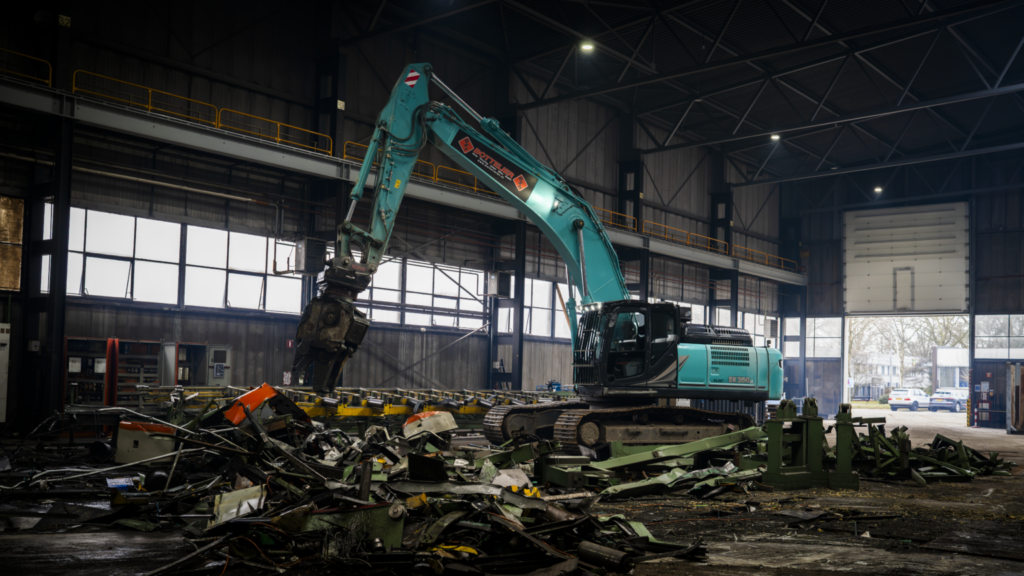
During plant decommissioning, chemical residues are safely disposed of via a structured process: identification, classification, cleaning of facilities, separate storage and transport by certified waste processors, followed by documented processing or destruction. This process is mandatory under Dutch and European legislation on hazardous substances and applies to every industrial decommissioning involving process installations. The questions below provide insight into how this works in practice, step by step.
Which chemical residues are most common during factory dismantling?
The most common chemical residues found during plant decommissioning are remnants of process chemicals, oils, solvents, acids, alkalis, and catalysts that remain in pipes, tanks, and reactor vessels after shutdown. Additionally, asbestos, chromium-6, and heavy metals are frequently found in older industrial facilities. The exact composition depends heavily on the sector and the substances produced.
In the petrochemical industry, this often involves hydrocarbons, benzene, and sulfur compounds. In the pharmaceutical industry, active pharmaceutical ingredients and solvents can remain as residues. The food industry has different risk profiles, in which cleaning agents and process additives play a role. At power plants, fly ash, lubricating oils, and cooling water conditioners are common residues.
What all these residues have in common is that, during dismantling, they cannot simply be disposed of as regular construction waste. They fall under the category of hazardous substances and require specific handling, storage, and transport. Precisely because installations can still contain significant quantities of these substances after shutdown, thorough preparation before the actual demolition work begins is indispensable.
How are chemical residues identified before demolition work?
Chemical residues are identified prior to demolition work through a combination of document review, physical inspection, and sampling. Based on process diagrams, safety data sheets, and company history, a specialized team compiles an inventory of all hazardous substances present. Additional measurements and laboratory analyses confirm the nature and concentration of the residues.
This preliminary investigation forms the basis for the safety plan and the waste management plan. Without a complete inventory, it is not possible to select the appropriate protective equipment, define the correct waste streams, or apply for the necessary permits. For complex installations, the investigation is carried out by a multidisciplinary team of process specialists, environmental experts, and safety experts.
Particular attention is paid to hidden residues: substances that have settled in the walls of reactor vessels, in insulation material, or in the soil surrounding the installation. It is precisely these hidden contaminants that are missed during a superficial inspection, but can still be released during the actual decommissioning and pose a risk to employees and the environment.
What are the legal requirements for the disposal of chemical waste during demolition?
The disposal of chemical waste during demolition is subject to the Environmental Management Act, the Hazardous Substances Decree, and the European REACH and CLP regulations. Hazardous waste may only be disposed of by approved collectors and processors, and every transfer must be documented by means of a consignment note in accordance with the Eural Code system.
Additional rules apply to specific substances. Asbestos-containing material falls under the Asbestos Removal Decree and may only be removed by certified companies holding the asbestos removal process certificate. Chromium-6 also requires specific control measures and reporting. For soil contamination resulting from leaked process chemicals, the Soil Protection Act and the associated remediation protocol apply.
Clients are legally obliged to ensure that the engaged demolition contractor possesses all necessary certifications and accreditations. In the event of a violation of the rules regarding hazardous waste, you, as the client, risk not only fines but also criminal liability. A documented handover, in which all waste streams are recorded in a traceable manner, is therefore not only a best practice but a legal obligation.
How does the actual disposal of hazardous chemical substances proceed step by step?
The actual disposal of hazardous chemical substances during factory dismantling follows a fixed sequence: first, cleaning of the installation; then, separate storage of the waste streams; followed by transport by an approved collector to a licensed processing facility. Each step is documented in writing and is traceable.
In practice, this process looks as follows:
- Shutdown and isolation: The installation is taken out of service and all supply lines are shut off and secured.
- Cleaning of installations: Tanks, pipes, and reactor vessels are rinsed, steamed, or chemically cleaned to remove residues. The cleaning water is collected separately as hazardous waste.
- Classification and packaging: The released substances are classified based on their hazardous properties and packed in approved containers or drums in accordance with ADR transport regulations.
- Temporary storage: The hazardous waste is temporarily stored in a liquid-tight, covered storage area with proper labeling and safety signage.
- Transport and processing: An approved collector transports the waste to a licensed processing facility. The consignment note and the digital waste register ensure full traceability.
- Documentation and delivery: Upon processing, the client receives a statement of processing, which forms part of the delivery file.
In industrial decommissioning, cleaning the installation before the actual dismantling is a step that must not be skipped. Even after thorough cleaning, residual concentrations may still be released when sawing or dismantling pipes and vessels, for which workers are equipped with the appropriate personal protective equipment.
How is chemical disposal carried out without production interruption?
Chemical disposal during partial dismantling can be carried out without interrupting the ongoing production process, provided that the section to be dismantled can be completely isolated from the active production line. This requires a detailed phasing and safety plan that is coordinated in advance with the client and all involved parties.
The key lies in a strict zoning of the activities. The work area is physically and procedurally separated from the operational installation. Pressurized ventilation, airlock and personnel procedures, and continuous gas detection ensure that hazardous substances do not enter the production environment.
In practice, specialized demolition companies work in shifts outside regular production hours or schedule the most high-risk activities during planned shutdown periods. Communication between the contractor's project team and the client's production manager is of great importance in this regard. Changes to the schedule or unexpected findings, such as higher residue than expected, are communicated immediately so that production is not unnecessarily impacted.
Which certifications must a demolition contractor have for chemical demolition projects?
For chemical demolition projects and plant dismantling involving hazardous substances, a demolition contractor must possess at least: VCA Petrochemicals, the asbestos removal process certificate (SC 530), ISO 14001 for environmental management systems, NEN-EN-ISO 9001 for quality management, and recognition as a collector of hazardous waste. Additional certifications, such as SIKB 7000, are required in the case of soil contamination.
Each of these certifications covers a specific risk or legal obligation:
- VCA Petrochemicals: Demonstrable safety knowledge for working in and around petrochemical and chemical installations.
- SC 530 (asbestos removal process certificate): Mandatory for the removal of asbestos-containing materials, which are present in many industrial facilities.
- ISO 14001: Ensures that the contractor systematically manages and documents environmental impact.
- NEN-EN-ISO 9001: Guarantees a controlled quality management system for all project steps.
- SIKB 7000 (protocols 7001/7004): Required when carrying out soil remediation as part of the dismantling.
- BRL SVMS-007: Relevant for demolition work where material flows are registered and reuse is ensured.
As a client, it is wise to always verify the validity of the certificates before awarding the contract. A broadly certified contractor offers not only legal certainty but also the technical depth required to dispose of chemical residues in a safe, traceable, and environmentally friendly manner.
How we help you safely dispose of chemical residues
We guide industrial clients through the entire factory dismantling process, from the initial inventory of hazardous substances to the documented handover of the site. Our approach is turnkey: you do not need to coordinate multiple parties for cleaning, asbestos removal, chemical waste transport, and demolition work. We handle this as a single point of contact.
What you can expect from us on a project involving chemical residues:
- A complete inventory of hazardous substances before the start of the work
- Tailor-made safety plans and risk analyses per project
- Certified industrial dismantling including cleaning, asbestos removal, and chromium-6 remediation
- Fully traceable disposal of hazardous waste with accompanying documentation
- Execution at installations in production without disruption of the business process
- A reuse rate of 99% for released material streams
Would you like to know how we handle your dismantling project? Contact us for a no-obligation consultation.