
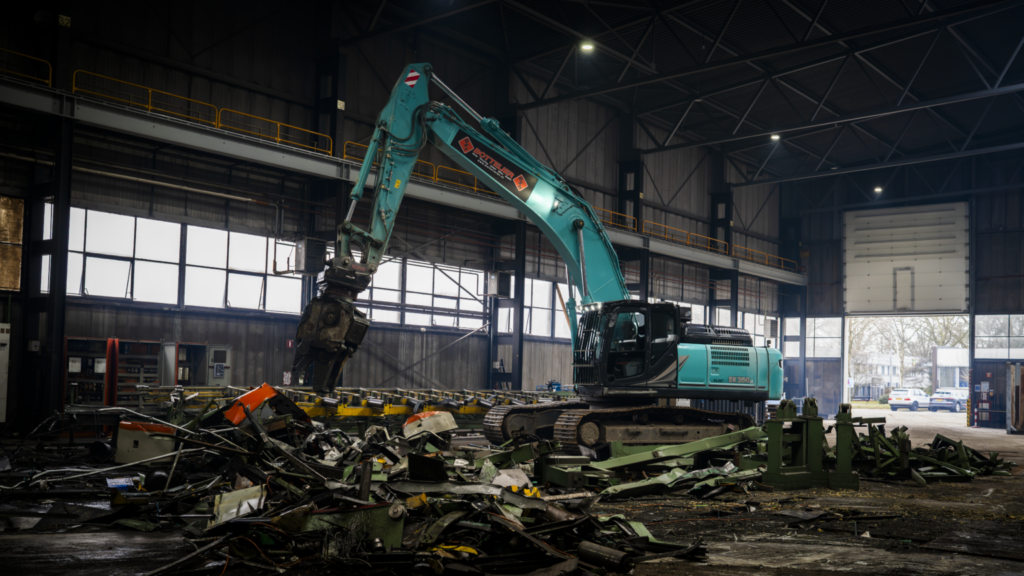
You reduce waste during the dismantling of production facilities by inventorying, separating, and strategically deploying materials for reuse or recycling as early as possible, rather than disposing of them in landfills. The more materials given a second life, the smaller the waste stream and the environmental impact of the project. The questions below provide a concrete picture of how this works in practice, from material management to asbestos remediation and waste management planning.
Which materials are released during the dismantling of production facilities?
During the dismantling of production facilities, large quantities of steel, concrete, copper, aluminium, process equipment, piping, insulation material, and hazardous substances such as asbestos are released. The exact composition varies by sector, but in industrial environments, metal and concrete structures typically dominate the released material flows.
In the (petro)chemical and energy sectors, contaminated materials are added to this, such as tanks and pipes containing chemical residues, or equipment with chromium-6-containing coatings. Different processing rules apply to each of these streams. Metals are highly reusable or recyclable, whereas hazardous materials must be remediated before they can be processed further. Proper material matching therefore begins with an accurate inventory before the first wrecking ball falls.
How does circular demolition work for industrial installations?
Circular demolition of industrial installations entails the selective dismantling and sorting of materials and components so that they can be reused or recycled to the maximum extent possible, rather than being disposed of as waste. The goal is to keep the loop as closed as possible and to limit the amount of material going to landfill to a minimum.
In practice, the circular dismantling of installations with a detailed dismantling plan. In this plan, it is determined for each component whether it should be reused, marketed, recycled, or destroyed. Process equipment such as pumps, compressors, and heat exchangers can be put back into service after cleaning. Structural steel goes to steel recycling. Concrete is crushed and used as aggregate for road foundations or embankment material.
The key to circular demolition is selective working: not demolishing in bulk and sorting afterwards, but making conscious choices for each material stream during the dismantling process itself. This requires well-trained supervisors and a logistical plan that keeps the different streams separate.
What is the difference between reuse, recycling, and landfilling for demolition material?
Reuse means that a material or component retains its original function and is deployed again. Recycling entails that the material is converted into a raw material for a new product. Landfill is the least sustainable option: the material disappears as waste and no longer yields any value. Reuse is always preferred over recycling, and recycling over landfill.
When reducing waste during dismantling, the order of these options determines the environmental impact. A steel frame that is dismantled intact and reinstalled elsewhere saves the energy and raw materials required for new steel production. A metal beam that is melted down for recycling still yields value, but requires more energy than direct reuse. Landfilling is in most cases both environmentally polluting and costly, as landfill fees apply to the disposal of construction and demolition waste.
For industrial clients, the distinction is also financially relevant: reusable equipment can be marketed, which reduces net demolition costs. Recyclable metal has residual value. Landfill material only costs money.
What role does asbestos removal play in waste reduction in demolition projects?
Asbestos remediation plays a direct role in waste reduction in demolition projects, because asbestos-containing materials must be removed and disposed of separately before other materials can be reused or recycled. If asbestos is not remediated in a timely manner, other material streams become contaminated and can no longer be reused, which increases the total waste stream.
In many older production facilities, asbestos has been incorporated into insulation, sheet materials, gaskets, and roofing. As long as this asbestos is present, the surrounding structures cannot be freely dismantled. Therefore, a thorough asbestos inventory and remediation is not a minor matter, but a prerequisite for effective waste reduction during the dismantling of production facilities.
After remediation, the released structures are available again for reuse or recycling. In this way, proper asbestos remediation indirectly contributes to a higher reuse rate of the overall project.
When do you need to draw up a waste management plan for a dismantling?
You draw up a waste management plan for a dismantling as soon as the project generates demolition waste or hazardous substances, which is the case with virtually every industrial dismantling. In the Netherlands, a waste management plan is legally required for demolition projects above a certain size or when hazardous materials such as asbestos are present.
In practical terms, you draw up the plan during the preparation phase, well before the start of the work. The plan describes which material flows are generated, how they are separated, who disposes of them, and where they go. A good waste management plan is not only a legal obligation but also a steering instrument to actively monitor waste reduction in the demolition project.
For complex industrial projects, the plan also includes a risk analysis for hazardous substances, a logistics schedule for material supply and removal, and agreements regarding documentation and reporting to the competent authority. The sooner you draw up this plan, the better you can manage waste streams and the higher the final reuse rate will be.
How do you achieve a reuse rate of 99% in demolition work?
A reuse rate of 99% in demolition work is achieved by managing material preservation as early as the planning phase, by selectively dismantling rather than demolishing, and by determining a concrete destination for every material stream. This requires a combination of technical expertise, logistical planning, and a network of buyers for reusable materials and raw materials.
In concrete terms, this means that process equipment is cleaned and marketed, metals are sorted and offered to steel recyclers, concrete is crushed into aggregate, and even smaller residual streams such as copper and aluminium are kept separate for recycling. Only materials that no longer have reusable or recyclable value after all processing steps end up as residual waste.
That percentage is not a given. It requires certified working methods, a well-trained execution team, and systematic registration of all material flows. Only in this way can you demonstrate to clients that the reuse goal has actually been achieved and comply with the reporting obligations associated with sustainable dismantling.
How we contribute to waste reduction during dismantling
We manage industrial dismantling projects from start to finish, with the aim of keeping the waste stream as small as possible and reusing materials at the highest possible quality. Our approach is concrete and measurable:
- We carry out a complete material linkage in advance, so that every material flow has a destination before the work starts
- We dismantle selectively and separate materials directly on site, maximizing the possibilities for reuse and recycling
- We handle asbestos removal as an integral part of the dismantling process, ensuring that other materials do not become contaminated
- We draw up a comprehensive waste management plan and ensure documented delivery, including reporting on reuse rates
- We achieve a reuse rate of 99%, demonstrably and certified
Our extensive certification, including ISO 14001, NEN-EN-ISO 9001, and CSR Performance Ladder Level 3, guarantees that we not only promise this but can also prove it. Would you like to know what we can do for your decommissioning project? Contact us and we will discuss the possibilities.