
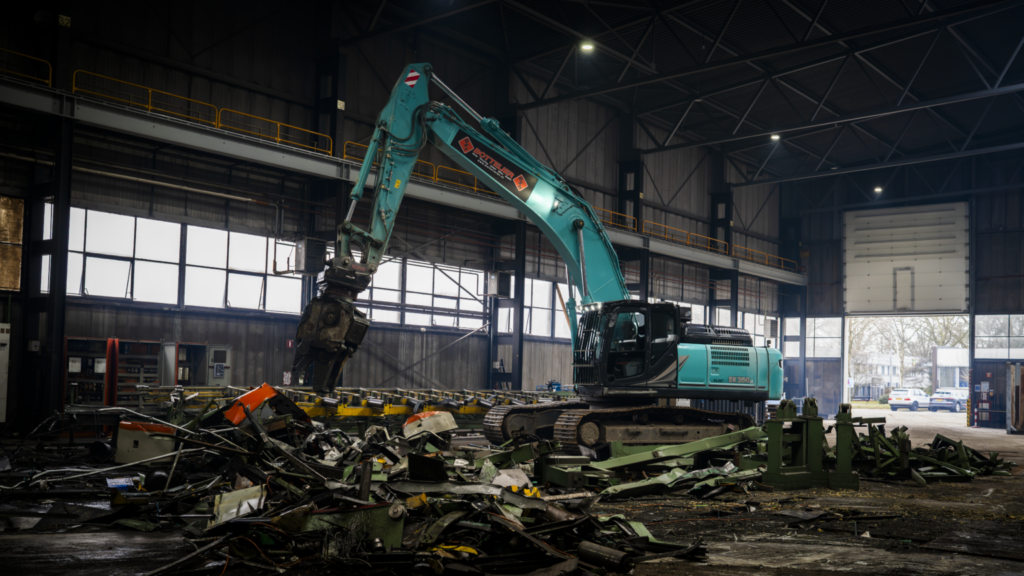
Industrial dismantling has a direct impact on the soil quality of a site. During the dismantling of installations, pipelines, and storage tanks, contaminants can be released that penetrate the soil—sometimes already present and now exposed—or spread further due to mechanical disturbances. It is therefore important for industrial clients to identify and manage soil risks early on. The questions below provide concrete answers to the most relevant aspects of dismantling and soil quality.
What soil risks arise during industrial dismantling?
During industrial dismantling, soil risks arise from the release of hazardous substances from installations, pipes, tanks, and floor structures. Examples include hydrocarbons, heavy metals, solvents, or process chemicals that have been stored or transported for years. As soon as installations are disconnected or removed, residues can leak out or end up in the soil due to mechanical disturbances.
Soil risks during industrial dismantling include:
- Leaks from residual fluids in pipes and tanks during disassembly
- Spread of contaminated groundwater due to the removal of sheet piling or foundations
- Dust dispersion of contaminated rubble or aggregate during demolition work
- Exposure of previously covered soil layers due to excavation work
- Infiltration of cleaning water used during installation cleaning
The risk is greater on sites where industrial activities have taken place for decades, because historical contaminations may have stabilized but are remobilized through dismantling. A thorough risk analysis prior to the work is therefore an important part of a responsible dismantling plan.
How deep can contamination penetrate the soil?
Soil contamination following demolition or dismantling can penetrate to depths of tens of meters, depending on the nature of the substance, the permeability of the soil, and the duration of exposure. Light volatile compounds such as benzene or trichloroethene sink relatively quickly through sandy soil layers. Heavy metals more often remain in the upper layers but can also migrate deeper with prolonged exposure.
Factors that determine the depth of contamination are:
- Soil composition: Sandy soils allow contaminants to penetrate faster than clayey soils.
- Groundwater level: A high groundwater level accelerates spread via groundwater
- Nature of the contamination: Water-soluble substances spread faster than oily compounds.
- Duration of exposure: Long-term leaks reach deeper layers than one-off incidents.
At complex industrial sites, it is not uncommon for contaminants to reach groundwater, which significantly increases the remediation challenge. This is one of the reasons why soil investigation should not be delayed during the dismantling of an industrial site.
When is a soil investigation mandatory for demolition work?
A soil investigation is mandatory for demolition work when an environmental permit is applied for the demolition or redevelopment of a site, or when the location is considered suspect based on historical use. The Soil Protection Act and the Environment and Planning Act require owners and clients to determine the soil quality before a site is given a new designation.
Specifically, a soil investigation is mandatory for demolition in the following situations:
- When applying for an environmental permit for demolition or new construction
- When the land is sold or transferred
- In the presence of underground tanks, asbestos, or hazardous substances
- When the soil is designated as suspect based on historical use
- Upon a change of zoning to sensitive use, such as residential construction
Even when a soil investigation is not legally required, it is advisable to document the initial condition of the soil from a liability perspective. This is certainly true for industrial decommissioning projects involving multiple parties.
What is the difference between soil remediation and soil monitoring after demolition?
Post-dismantling soil remediation is an active intervention in which contaminated soil or groundwater is cleaned, excavated, or isolated. Soil monitoring is a passive measure in which soil quality is tracked over time without direct intervention. Both approaches complement each other but are deployed based on the severity and spread of the contamination.
The difference in practice:
- Soil remediation: Removal or cleaning of contaminated soil, biological or chemical treatment, groundwater pumping, or in-situ techniques. This is necessary when the contamination poses a risk to people, the environment, or the future use of the site.
- Soil monitoring: Periodic measurement of groundwater quality and soil parameters via piezometers. This is applied when contamination is stable and poses no immediate risks, but still needs to be monitored.
The choice between remediation and monitoring depends on the risk assessment, the future use of the site, and the requirements of the competent authority. When an industrial site is redeveloped for a different function, soil remediation after dismantling is necessary in most cases.
How does circular demolition prevent additional soil damage?
Circular demolition prevents additional soil damage by selectively dismantling and separating materials before heavy demolition work begins. As a result, pollutants are removed in a controlled manner rather than being crushed or dispersed. Selective dismantling also reduces the amount of demolition waste remaining on site and the risk of contaminated water seepage.
Concrete benefits of circular demolition for soil quality are:
- Hazardous substances such as asbestos, oil, and chemicals are disposed of separately before demolition work begins
- Reusing materials reduces the amount of rubble and soil that needs to be disposed of
- Fewer heavy machines on the site mean less soil compaction and less risk of damaging underground pipes
- Documentation of all material flows makes soil contamination control easier
A reuse rate of 99% is achievable with circular demolition, which simultaneously significantly reduces the environmental impact of the project. This is beneficial not only for the soil but also for the total CO2 footprint of the demolition project.
Who is liable for soil contamination after demolition?
Liability for soil contamination after demolition rests primarily with the owner or user of the site at the time the contamination occurred. In practice, this means that the client is responsible for having a soil investigation carried out and reporting any contamination to the competent authority. The contractor is liable for damage caused during the execution of the demolition work.
Liability is divided among multiple parties:
- Site manager or owner: Responsible for historical contamination and having mandatory soil investigations carried out.
- Client: Responsible for correctly informing the contractor about known contamination and complying with permit requirements.
- Demolition company or contractor: Liable for new contamination arising during the works due to negligence or careless conduct
It is therefore important to make clear contractual agreements regarding the division of responsibilities prior to a decommissioning project. A thorough baseline assessment of soil quality protects all parties involved and prevents subsequent disputes regarding who is liable for which contamination.
How we help you with demolition and soil quality
We handle the entire industrial dismantling process, including all steps to protect the soil quality of your site. From the initial risk analysis and soil investigation to the documented delivery of a construction-ready site. Our approach is turnkey, which means that as the client, you do not need to deal with multiple parties.
What we arrange for you:
- Preliminary investigation and risk analysis of soil contamination on your site
- Permit applications and notifications to the competent authority
- Selective dismantling and circular demolition to prevent additional soil damage
- Cleaning of installations and safe disposal of hazardous residues
- Soil remediation after dismantling if necessary, combined with soil monitoring
- Documented handover with complete file of material flows and soil quality
Would you like to know what we can do for your dismantling project? Contact us and we will discuss the possibilities.