
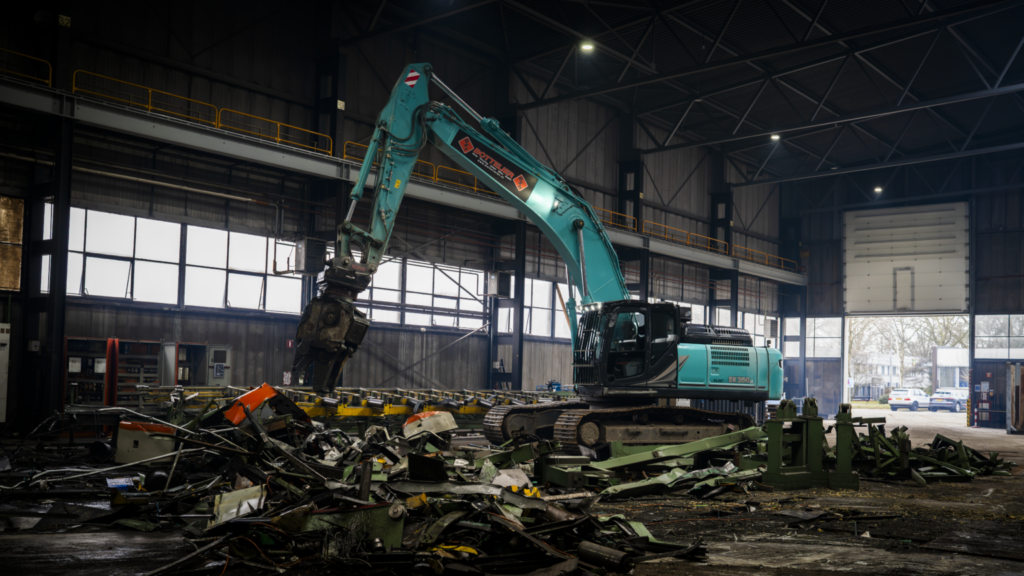
Decommissioning and renovation of a factory are two fundamentally different approaches. Decommissioning involves completely removing installations, buildings, or production lines from use, whereas renovation focuses on modernizing or adapting existing structures without completely removing them. The choice between the two depends on the technical condition, the economic lifespan, and the future plans for the industrial asset. In this article, we answer the most frequently asked questions about this difference.
When do you choose dismantling instead of renovation?
You opt for decommissioning when an installation or plant has reached the end of its economic or technical lifespan and renovation is no longer profitable or feasible. Renovation makes sense as long as the basic structure remains intact and modifications significantly improve functionality. Decommissioning becomes the logical choice once the costs of renovation exceed the remaining value or useful life.
Concrete situations in which dismantling is preferred:
- The installation or building no longer meets current safety standards and cannot be cost-effectively modified
- The production process is changing fundamentally, rendering existing infrastructure obsolete
- There is serious contamination, such as asbestos or soil contamination, which makes renovation impractical
- The site will be given a completely different purpose
- The remaining technical lifespan of the installation is too short to recoup investments in renovation
Renovation is actually the better choice if the load-bearing structure or the building shell is still in good condition and only specific parts need to be replaced or modernized. In practice, industrial clients sometimes combine both: partial dismantling of outdated installations, followed by renovation of the remaining structure.
What does a complete dismantling process entail?
A complete factory dismantling process encompasses the systematic decommissioning, cleaning, dismantling, and removal of all installations, pipelines, equipment, and structural elements. The process runs from the initial inventory and permit application to the documented, construction-ready handover of the site.
The main phases in an industrial dismantling process are:
- Inventory and planning: Technical assessment of the installation, risk analysis, safety plan and action plan
- Permits and notifications: Applying for demolition permits and environmental permits, and notifying asbestos removal to the competent authorities.
- Cleaning and decontamination: Removal of hazardous residues from pipes, tanks, and equipment after shutdown
- Asbestos and chromium-6 remediation: Safe removal of hazardous materials in accordance with statutory certification requirements.
- Dismantling of installations: Systematic dismantling of production lines, equipment, and piping
- Demolition work: Demolition of structural elements such as buildings, foundations, and chimneys
- Disposal, reuse, and recycling: Sorting and processing released materials, aimed at maximum reuse
- Soil remediation and handover: Remediation of any soil contamination and delivering the site ready for construction.
The complexity of industrial dismantling lies primarily in cleaning and decontamination. After shutting down a plant, hazardous and toxic residues can remain in pipes and equipment in the (petro)chemical, pharmaceutical, or energy sectors. Specific procedures and certifications are required for this.
Which activities fall under industrial renovation?
Industrial renovation involves modifying, replacing, or modernizing installations, buildings, or infrastructure without completely removing them. The goal is to extend service life, increase efficiency, or comply with new laws and regulations, while preserving the basic structure.
Typical activities in industrial renovation are:
- Replacing outdated machines or process equipment with new generations
- Modifying or expanding piping, electrical installations, and control systems
- Renovation of roofs, facades, or floors of industrial buildings
- Making the energy system more sustainable, such as insulation or new installations
- Modifications to comply with changed safety or environmental standards
- Partial dismantling of outdated components in preparation for new installations
The difference compared to dismantling is that with renovation, the continuity of the object is central. The factory or installation remains in use or is put back into use after renovation. With dismantling, the end result is the complete clearing of the site or space.
Can dismantling take place while a factory is in operation?
Yes, the dismantling of specific installations or building sections can take place while other parts of a factory remain in operation. This requires precise planning, strict shielding of work zones, and intensive coordination with the client to avoid disrupting the production process.
In practice, this occurs regularly at large industrial complexes where outdated production lines are dismantled while active lines continue to operate. The challenge lies in managing safety risks, vibrations, dust, and noise that can affect the operational section. Proper compartmentalization and clear communication protocols are indispensable prerequisites in this regard.
Furthermore, for the (petro)chemical industry and energy sector, shut-down installations adjacent to active systems require extra attention during cleaning and decontamination. Hazardous residues must not reach the active production environment. This requires specialized knowledge of both the production process and the demolition work.
What are the environmental and permit requirements for dismantling?
When dismantling a factory, you face multiple legal obligations regarding permits, notifications, and environmental legislation. The precise requirements depend on the scale of the project, the presence of hazardous substances, and the location, but a number of obligations apply in almost all cases.
The main environmental and permit requirements are:
- Environmental permit for demolition works: Required for demolition works exceeding a certain size, applied for at the municipality or the competent authority.
- Asbestos survey report: Legally required before any demolition activity; carried out by a certified agency
- Asbestos removal notification: Mandatory notification to the Inspectorate SZW when removing asbestos
- Soil investigation: Often required to establish the initial situation and plan any potential soil remediation.
- Waste registration: Released materials must be registered and processed in accordance with the Environmental Management Act.
- Environmental permit or spatial plan: For large-scale dismantling with significant environmental effects, an additional environmental permit may be required.
For industrial sectors such as the (petro)chemical industry, additional requirements apply under BRZO legislation (Decree on Risks of Major Accidents) when decommissioning hazardous installations. It is important to start the permitting processes early, as processing times at competent authorities can be substantial and cause project delays.
How does the cost structure of demolition and renovation differ?
Dismantling and renovation have fundamentally different cost structures. With dismantling, costs are largely one-off and focused on the removal and processing of materials, whereas renovation leads to investments that are recouped over a longer useful life. Dismantling can be partially financed by the residual value of released materials and installations.
For dismantling, the costs consist of:
- Preparation: inventories, permits, safety plans and risk analyses
- Cleaning and decontamination of installations
- Asbestos remediation and removal of other hazardous substances
- Dismantling of installations and demolition work
- Disposal, processing and recycling of released materials
- Potential soil remediation
An important distinction is that materials released during dismantling can represent a residual value. Reusable installations and raw materials are marketed or reused, which lowers the net cost of the dismantling project. With a reuse rate of 99%, the impact of this is significant.
In a renovation, costs consist of investments in new equipment, adjustments to the infrastructure, and labor hours for installation and commissioning. The total investment is often better spread over time, but also requires a realistic assessment of the remaining lifespan of the structure to be renovated. Renovating an installation that will have to be dismantled in five years anyway rarely yields a positive return.
How we help you with dismantling or renovation issues
Are you unsure whether dismantling or renovation is the right choice for your industrial asset? We guide you through the entire process, from the initial assessment to documented delivery. As a specialized partner in industrial dismantling, we offer:
- An independent technical assessment of your installation or factory
- Turnkey dismantling solutions including cleaning, dismantling, asbestos removal, and soil remediation
- Fully managed permit processes and notifications to competent authorities
- Execution at installations in production, without disruption to your business process
- A reuse rate of 99%, with which we minimize environmental impact and maximize residual value
- Broad certification, including ISO 14001, NEN-EN-ISO 9001, SC 530, and VCA Petrochemicals
Do you want to know the best approach for your project? Contact us and we will be happy to think it through with you.