
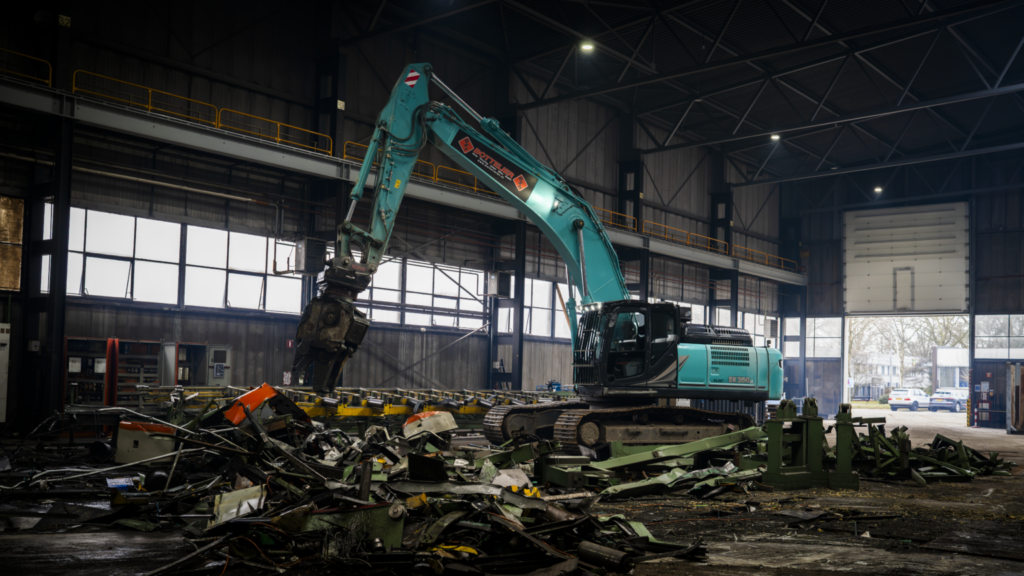
Selective demolition during the dismantling of factories proceeds in a fixed sequence: first, inventory and preparation; then, remediation of hazardous substances; followed by controlled dismantling of installations; and finally, processing of released materials. This approach differs fundamentally from conventional demolition because each component is deliberately assessed for reuse, recycling, or responsible disposal. The following questions walk through the entire demolition process step by step.
What distinguishes selective demolition from conventional demolition techniques?
Selective demolition is a controlled method in which materials and components are separated based on their reuse potential, in contrast to conventional demolition where an object is dismantled as a whole without distinguishing between material flows. In industrial dismantling, this difference is immediately visible in the yield, environmental impact, and compliance with laws and regulations.
In conventional demolition, everything is mixed together: steel, concrete, hazardous materials, and installations are removed simultaneously and disposed of as mixed rubble. In selective demolition , materials are cleared by category and kept separate. Steel structures, piping, electrical components, and concrete foundations each follow their own processing route.
For factories and industrial installations, selective demolition is not only a deliberate choice but also a legal obligation. The Environmental Management Act and the associated demolition notification require that hazardous substances be inventoried and removed separately before the actual demolition work begins. Industrial dismantling therefore requires an approach that combines technical expertise, environmental knowledge, and logistical planning.
The result of selective and circular demolition is measurable: a reuse rate of 99% is achievable when the process is well organized. This means less waste going to landfill, lower processing costs, and demonstrably more sustainable operations for the client.
Which preparatory steps are mandatory before dismantling?
Before the dismantling of a factory, four preparatory steps are mandatory: an asbestos survey by a certified agency, a demolition notification to the municipality, a safety and risk analysis, and the cleaning of installations to remove hazardous residues. Without these steps, demolition work may not legally commence.
The asbestos inventory is the starting point. An independent, certified company maps all asbestos-containing materials and records this in a report. This report forms the basis for the remediation approach and is a mandatory part of the demolition notification.
The demolition notification must be submitted to the relevant municipality at least four weeks before the start of the work. Additional permit requirements apply to larger projects or projects involving hazardous substances. The demolition notification includes, among other things, the demolition plan, the waste forecast, and the safety measures.
In addition to legal obligations, an industrial installation requires thorough cleaning before dismantling. After shutting down an installation, toxic or harmful residues may remain in pipes, tanks, and reactors. Examples include chemicals, oils, or process residues from the (petro)chemical industry. These substances must be removed and processed before technicians can safely begin the dismantling.
Finally, a detailed plan of action drawn up including a phasing of the activities, a communication plan, and a risk analysis. For factories that remain partially in production during dismantling, this plan is particularly important to ensure business continuity.
How are hazardous substances such as asbestos removed during demolition?
Hazardous substances such as asbestos are removed during industrial demolition by certified specialists under strict containment measures and using personal protective equipment. The removal always takes place before other demolition work begins in the area concerned and is concluded with a clearance measurement by an independent party.
For asbestos remediation, the requirements of the Working Conditions Decree and the field-specific certification scheme SC 530 apply. Only companies holding this certificate are permitted to remove risk class 2 and risk class 3 asbestos. The work is carried out in a shielded work area with negative pressure to prevent asbestos fibers from escaping into the environment.
In addition to asbestos, other hazardous substances are also present during industrial dismantling:
- Chromium-6, present in old paint layers on steel structures
- PCBs, in transformers and capacitors of older installations
- Process residues in pipes and tanks, such as hydrocarbons or corrosive substances
- Soil contamination around installations that were in use for years
Each type of hazardous substance requires its own remediation protocol and certified processing. The released waste materials are transported to recognized processing facilities, in accordance with the requirements of the Environmental Management Act and the EVOA regulations for the transboundary transport of hazardous waste.
In what order are factory parts dismantled?
Factory components are dismantled from top to bottom and from inside to outside: first the installations and equipment on higher levels, then the process installations and piping, followed by the supporting structures, and finally the foundation. This sequence guarantees the stability of the object during the demolition process and protects the safety of the work area.
The dismantling of a factory typically follows these phases:
- Installations and equipment: reactors, tanks, heat exchangers, pumps, and compressors are cleared and removed first. Reusable parts are left intact and stored separately.
- Piping and electrical installations: pipelines, cables, and instrumentation are systematically dismantled by system or circuit.
- Steel structures and floors: the load-bearing structures of the installation are removed after all overlying elements have been cleared.
- Buildings and canopies: the structural envelope of the installation is demolished after the technical installations have been removed.
- Foundations and underground structures: finally, concrete foundations, basements, and underground pipes are removed, possibly combined with soil remediation.
For factories that remain partially operational during dismantling, the phasing is aligned with the production process. For instance, a production line can be shut down and dismantled while adjacent lines continue running, provided the appropriate guarding and safety measures are taken.
Which materials can be reused after selective demolition?
Following the selective demolition of a factory, steel, non-ferrous metals, process equipment, electrical components, and concrete rubble are the main material streams eligible for reuse or recycling. The extent of reuse depends on the condition of the material and market demand.
Steel is by far the most valuable material stream in industrial dismantling. Structural steel, pipes, and profiles are sorted, cleaned, and offered to steel traders or directly reused in new projects. Non-ferrous metals such as copper, aluminium, and brass have a high market value and are kept separate.
Process equipment such as pumps, compressors, heat exchangers, and electric motors can, provided they are in good condition, be dismantled, cleaned, and put back on the market. This prevents the scrapping of functional components and reduces the demand for new production.
Concrete rubble is crushed into aggregate and used as a foundation in road construction or as fill material. In this way, even heavier construction material gets a second life instead of ending up in a landfill.
In circular demolition, all material flows are documented: which material has been reused, which has been recycled, and which has been disposed of as waste. This documentation is relevant for clients who are required to report on their sustainability performance or who work within a circular procurement objective.
Which certifications must a demolition company have for industrial dismantling?
For industrial dismantling, a demolition company must possess at least SC 530 (asbestos removal process certificate), VCA or VCA Petrochemicals, and BRL SVMS-007. Additional certifications such as ISO 14001 and NEN-EN-ISO 9001 are not mandatory but are expected as standard by industrial clients.
These are the most relevant certifications for industrial demolition projects:
- SC 530: mandatory for the removal of asbestos in risk classes 2 and 3. Without this certificate, a company may not carry out asbestos remediation.
- BRL SVMS-007: the quality standard for demolition work in the Netherlands. Demonstrable that the company works according to established procedures for selective demolition and material separation.
- VCA Petrochemicals: required for work in the petrochemical industry and refineries. More rigorous than standard VCA and specifically focused on the risks of that sector.
- ISO 14001: certification for environmental management systems. Demonstrates that the company systematically controls and improves environmental impact.
- NEN-EN-ISO 9001: quality management system. Relevant for clients who have requirements for process control and documentation.
- SIKB 7000 (protocol 7001/7004): applicable when soil remediation is part of the project.
The more certifications a demolition company holds, the more versatile it is for complex industrial projects. Clients in the chemical, pharmaceutical, or energy sectors typically set specific certification requirements in their tender documents. It is therefore advisable to check the validity and scope of certificates when selecting a demolition partner.
How we guide you through the dismantling of your factory
We guide industrial clients through the entire dismantling process, from the initial survey to the documented handover of a construction-ready site. Our approach is turnkey: you have a single point of contact for all disciplines.
What we arrange for you:
- Asbestos inventory, remediation plan and permit applications
- Cleaning of installations before dismantling
- Selective and circular dismantling of complete production lines
- Marketing of reusable equipment and materials
- Soil remediation and preparation of the site for construction
- Complete documentation of material flows for sustainability reporting
We work with a reuse rate of 99% and are certified for VCA Petrochemistry, SC 530, ISO 14001, NEN-EN-ISO 9001, BRL SVMS-007, and CSR Performance Ladder Level 3. This makes us suitable for the most complex industrial projects, including installations that remain partially in production. Contact us to discuss what we can do for your decommissioning project.