
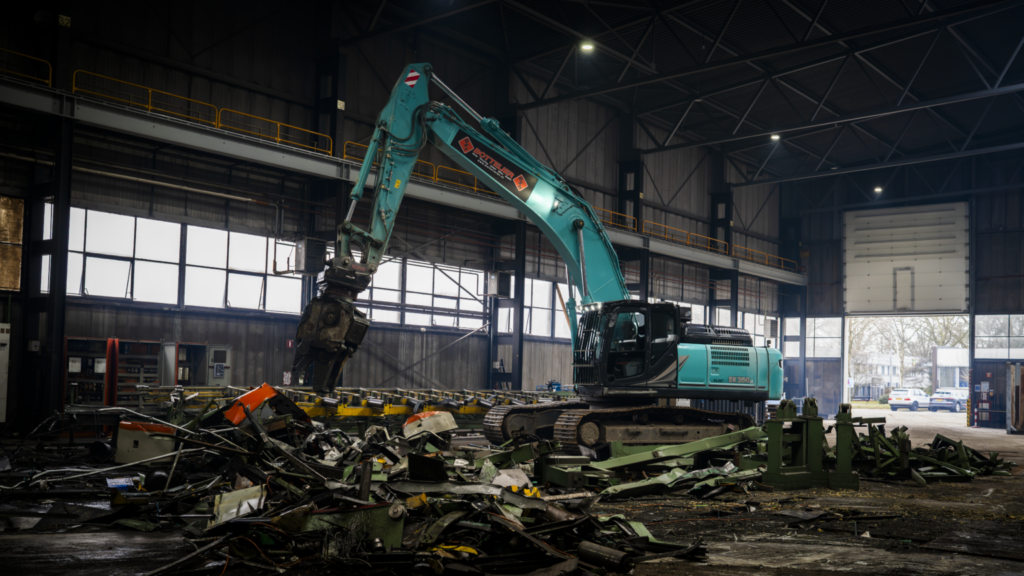
Digitization is fundamentally changing factory decommissioning planning: project teams work faster, more accurately, and more safely because digital tools translate complex information into concrete work instructions. Whereas traditional demolition planning relied heavily on paper drawings and the experience of site managers, digital planning offers real-time insight into risks, material flows, and phasing. In this article, we answer the most frequently asked questions about digitization in industrial decommissioning and planning.
Which digital tools are used in factory dismantling?
During factory decommissioning, digital tools are deployed such as BIM software, 3D laser scanning, drone surveillance, digital risk analysis platforms, and project management software. Together, these tools provide a complete digital view of the installation, the environment, and the planned work, enabling project teams to make better-informed decisions before the first wrecking ball falls.
The most commonly used technologies in industrial dismantling are:
- 3D laser scanning: creates an accurate digital model of existing installations, even if technical drawings are missing or outdated.
- BIM (Building Information Modelling): integrates all project data into a single model, from construction details to demolition sequence
- Drone surveys: offer safe visual inspections of hard-to-reach structures such as chimneys, roofs, and higher installations.
- Digital risk analysis platforms: linking hazardous substances, structural risks, and environmental factors to specific work locations
- Project management software: centrally tracks planning, communication, and documentation for all involved
The power of digital tools in factory dismantling lies not in a single application, but in the combination. A 3D scan that is directly loaded into a BIM environment provides contractors and clients with a shared point of reference that paper drawings could never offer.
How does BIM improve the preparation of a demolition project?
BIM improves the preparation of a demolition project by bringing together all relevant project information—from construction details and material properties to safety risks and phasing—into a single shared digital model. This prevents conflicting information between disciplines and makes it possible to virtually simulate the demolition sequence before execution.
In complex industrial projects, preparation is crucial for success. BIM makes it possible to:
- To visualize and optimize the demolition sequence step by step
- To detect conflicts between disciplines (construction, installations, asbestos) early
- To calculate quantities of materials and waste streams in advance
- Link safety plans to specific locations in the model
- To improve communication with clients through understandable 3D visualizations
Especially during factory dismantling, where production processes continue in the immediate vicinity, BIM helps to map interfaces and risk zones in advance. This reduces unnecessary downtime and increases safety for everyone on the site.
What is the difference between traditional and digital demolition planning?
Traditional demolition planning is based on paper drawings, manual inventories, and the experience of the site manager. Digital demolition planning works with real-time data, integrated models, and simulation tools that make deviations visible more quickly and make adjustments easier. The biggest difference lies in response speed and information sharing.
Traditional planning: strong in simplicity, vulnerable in complexity
For smaller demolition projects, traditional planning often works perfectly well. Site managers with years of experience know the risks and can adapt quickly. The problem arises with large-scale industrial dismantling: drawings no longer correspond to reality, information regarding hazardous substances is fragmented, and coordination between parties proceeds slowly via email or telephone.
Digital planning: faster, shareable, and scalable
Digital demolition planning solves these bottlenecks. Everyone involved, from project manager to site supervisor, works based on the same up-to-date information. Changes are implemented immediately and are visible to everyone. In factory dismantling in active environments, this is not a luxury but a necessity to ensure safety and continuity.
How does digitalization contribute to safety during dismantling?
Digitalization contributes to safety during decommissioning by enabling risks to be identified earlier, better documented, and directly linked to work locations and activities. Digital tools make it possible to mark hazardous zones in a 3D model, so that operators know exactly what to look out for before entering an area.
Concrete contributions of digitalization to safety in industrial dismantling:
- Digital risk maps: linking hazardous substances such as asbestos or chromium-6 to specific locations in the demolition model
- Drone surveys: visualize structural weaknesses without people having to work in dangerous positions.
- Digital toolbox meetings: ensuring that safety instructions are always up-to-date and traceable
- Sensor monitoring: measures vibrations, temperature, or dangerous concentrations in real-time and sounds an alarm in case of deviations
When dismantling installations in the petrochemical or process industry, where harmful residues may be present after shutdown, digital risk documentation is not only useful but also legally relevant. It provides clients with demonstrable proof of careful conduct.
When does digital planning pay off in industrial demolition projects?
Digital planning pays off in industrial demolition projects whenever the complexity, scale, or risks of a project exceed the limits of traditional coordination. This applies to projects involving multiple disciplines, active environments, hazardous materials, tight timelines, or high demands on documentation and accountability.
Specific situations where digital demolition planning offers clear added value:
- Dismantling of complete production lines or factories with multiple installations
- Demolition work that takes place alongside or within an active production process
- Projects where asbestos, chromium-6, or other hazardous substances are present
- Situations where reuse of materials and circular reporting are expected
- Projects with multiple contractors, subcontractors, and clients who need to communicate in real time
For smaller, simple demolition jobs, the investment in extensive digital tooling may outweigh the benefits. However, for large-scale industrial dismantling, the opposite is true: the costs of errors, downtime, or unsafe situations far exceed the investment in digital planning.
How does digitalization influence the circular flow of materials in demolition?
Digitization makes the circular flow of materials in demolition more transparent and manageable. By digitally inventorying and classifying materials as early as the planning phase, valuable raw materials can be specifically separated, reused, or offered for remarketing instead of ending up as waste.
Digital tools support circularity in multiple ways:
- Material inventory in BIM: maps the quantities and quality of steel, concrete, copper, and other materials before demolition begins.
- Digital material passports: record the origin and quality of released materials, facilitating reuse and marketing.
- Waste stream registration: documents which materials go where, which supports reporting for environmental certification
- Integration with marketplaces: digital platforms make it easier to offer reusable installations and materials to interested buyers.
By intelligently inventorying and managing materials, the reuse rate increases significantly. This is not only good for the environment but also reduces disposal costs and increases the residual value of a dismantling project for the client.
How we help with digital planning of factory dismantling
As specialists in industrial dismantling, we combine years of technical expertise with modern digital working methods. We offer clients a complete turnkey process where digitalization is not an end in itself, but a means to execute projects more safely, faster, and more sustainably. What you can expect from us:
- Detailed digital preparation including risk analysis and demolition sequence
- Use of 3D scanning and BIM for accurate project planning
- Real-time communication and documentation for all involved
- Circular materials approach with a reuse rate of 99%
- Full certification, including ISO 14001, NEN-EN-ISO 9001 and SC 530
Would you like to know how digital planning can concretely improve your decommissioning project? Contact us , and we will be happy to brainstorm with you.