
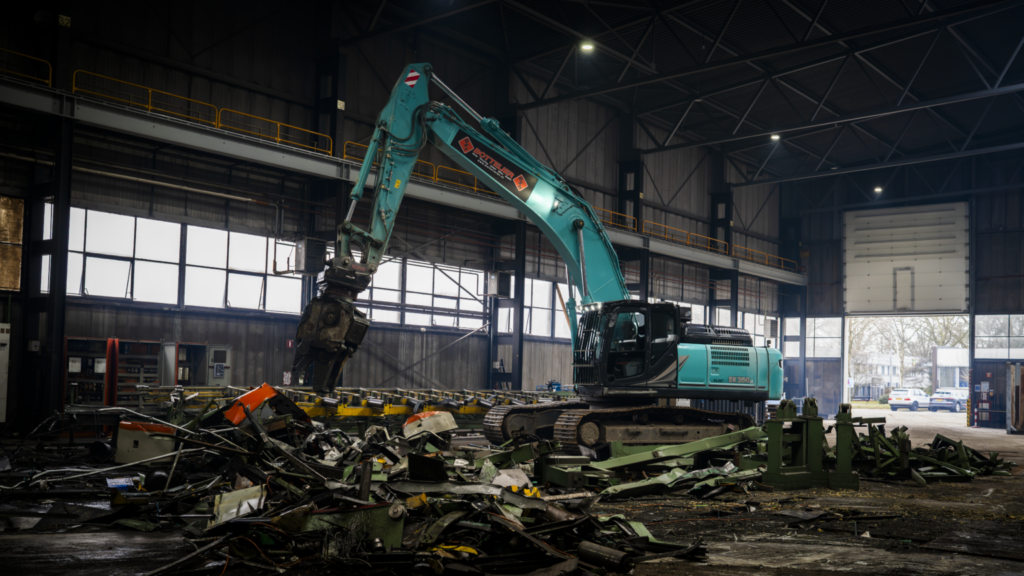
The dismantling of obsolete production facilities entails a range of technical, legal, and logistical challenges. These include hazardous substances such as asbestos, the complexity of working around active processes, and the need to comply with strict environmental and safety requirements. For industrial clients, it is important to thoroughly map out these challenges in advance. In this article, we answer the most frequently asked questions about demolition work in the industry.
Which safety risks play a role in industrial dismantling?
During the dismantling of production facilities, safety risks are significantly greater than in regular demolition projects. Outdated installations may contain hazardous residues, such as toxic gases, flammable liquids, or chemical residues that remain in pipes and tanks after shutdown. Without proper cleaning procedures, these substances pose a direct danger to employees and the environment.
In addition to chemical risks, physical hazards also play a major role. Unstable structures, significant height differences, and heavy equipment in confined spaces require detailed risk analyses and safety plans before work begins. Industrial dismantling projects therefore call for an approach where safety is not addressed retrospectively, but is embedded in the project plan from the outset.
Relevant safety measures for industrial dismantling include:
- Extensive cleaning of installations before the start of demolition work
- Personal protective equipment adapted to the specific hazardous substances at the site
- Detailed risk analyses per project phase
- Certification of executing parties, such as VCA Petrochemistry and SC 530
How is asbestos handled during the demolition of old factories?
During the demolition of obsolete factories, asbestos is handled through a strictly certified remediation process that is legally required. First, a certified inspector conducts an asbestos survey to map the nature, location, and quantity of asbestos material. Subsequently, a specialized contractor removes the asbestos under controlled conditions before the actual demolition work begins.
Many outdated production facilities contain asbestos in insulation material, roofing, gaskets, and piping. The approach differs depending on the type of asbestos: bonded asbestos requires a different method than non-bonded material, which is considered more hazardous and requires stricter measures.
during the industrial dismantling of chemical or petrochemical installations, as asbestos often occurs in combination with other hazardous substances such as chromium-6. In such cases, a certified demolition partner with an asbestos removal process certificate and the necessary SVMS-007 certification is not a luxury, but a legal requirement.
What makes dismantling during ongoing production so complex?
Dismantling during ongoing production is complex because demolition work and active business processes literally get in each other's way. Vibrations, dust, noise, and the presence of heavy equipment can damage production equipment or endanger employees. At the same time, the continuity of the production process must not be interrupted, which requires precise phasing and coordination.
The challenges are concrete and multifaceted:
- Strict zoning between demolition area and active production spaces
- Working outside regular production hours or in defined time windows
- Continuous communication between the demolition partner and the client's operational teams
- Adjustment of work schedule based on production rosters and safety protocols
This type of project requires not only technical expertise but also a high degree of flexibility and project management experience. A demolition partner with demonstrable experience in dismantling around active installations offers a clear advantage here.
Which permits are required for demolishing a production facility?
Demolishing a production facility typically requires multiple permits and notifications. The specific requirements depend on the scale of the project, the presence of hazardous substances, and the location. In most cases, this involves an environmental permit for demolition, an asbestos inventory report, and possibly a notification under the Environmental Management Activities Decree.
For larger industrial projects, additional requirements apply:
- An environmental permit for the disposal of hazardous waste
- Notifications to the Environmental Service or the competent authority
- Approval of a demolition safety plan by the municipality or province
- Specific permits in the presence of soil contamination or groundwater risks
Applying for and coordinating these permits takes time and requires knowledge of the relevant laws and regulations. An experienced demolition partner typically takes over this permit process completely as part of a turnkey approach, allowing you to focus on preparing your own organization.
How is demolition waste from industrial facilities reused?
Demolition waste from industrial facilities is reused by carefully separating and sorting materials by type and quality during dismantling. Steel, concrete, copper, and other metals are recovered for recycling or direct resale. Materials that are not directly reusable are processed into secondary raw materials for other industrial applications.
Circular demolition is therefore not a marketing term but a concrete working method. By dismantling installations rather than demolishing them, valuable components remain intact. Complete production lines or machines can be marketed or relocated to other locations, which makes both economic and ecological sense. A reuse rate of 99% is achievable when dismantling and sorting are carried out carefully.
For industrial clients, this also has a financial advantage: the residual value of reusable materials can be factored into the total project costs, which reduces the net demolition costs.
When is a turnkey demolition partner the right choice?
A turnkey demolition partner is the right choice when a project is too complex, too extensive, or too risky to coordinate in-house. This applies particularly to the dismantling of outdated production facilities, where multiple disciplines converge: asbestos removal, soil remediation, dismantling, permit applications, and documented handover. A turnkey approach means that a single party manages the entire process and unburdens the client.
In practical terms, a turnkey partner is sensible when:
- The hazardous substances project includes those that require specialized certification
- Work is being carried out around active production processes
- The timeline is tight and coordination errors have immediate financial consequences
- Multiple permit processes must run in parallel
- Sustainability objectives or reporting obligations apply to material processing
How we help with the dismantling of production facilities
We guide industrial clients through the entire process of demolishing production facilities, from the initial survey to the documented delivery ready for construction. Our approach is concrete and turnkey:
- We handle the complete permit applications and risk analyses
- We carry out asbestos removal, chromium-6 removal, and cleaning before the demolition work begins
- We dismantle complete production lines and installations with an eye for reuse and residual value
- We work around active processes without disrupting your business operations
- We hold certifications such as VCA Petrochemicals, ISO 14001, NEN-EN-ISO 9001, SC 530, and CSR Performance Ladder Level 3
Whether it concerns a chemical plant, a power plant, or a complete factory: we offer the expertise and certification to execute the project safely, efficiently, and as sustainably as possible. Contact us to discuss what we can do for your project.