
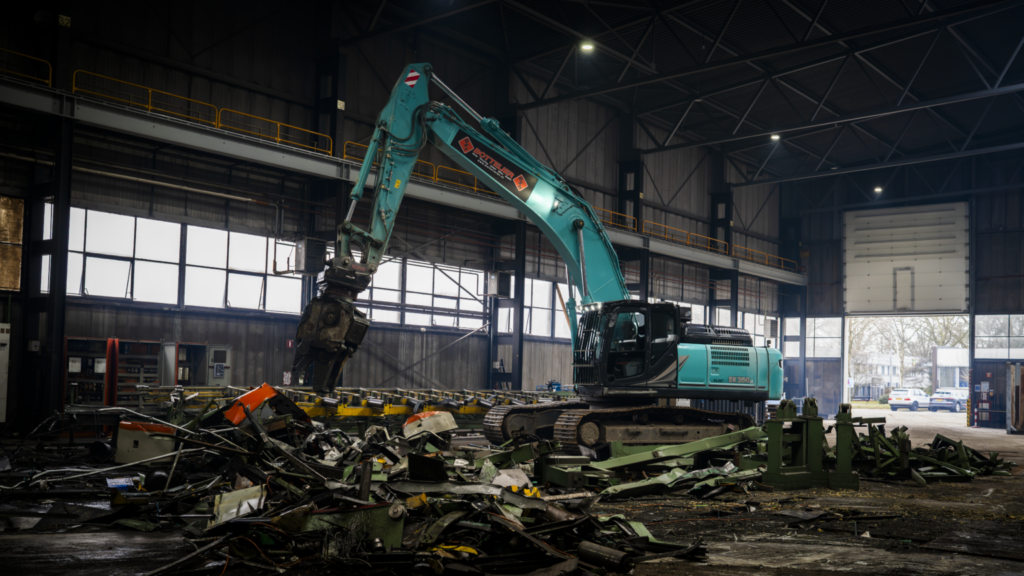
Strict environmental requirements under both national and European legislation apply to the dismantling of production facilities. You face mandatory inventories of hazardous substances, permitting requirements, waste separation requirements, and certification requirements for the executing contractor. These requirements apply to every industrial client decommissioning an installation, factory, or production line. In this article, we answer the most frequently asked questions regarding environmental legislation in industrial demolition and dismantling.
What laws and regulations apply to industrial dismantling?
In industrial dismantling, you deal with multiple legal frameworks simultaneously. The most important are the Buildings and Living Environment Decree (Bbl) under the Environment and Planning Act, the Environmental Management Act, the Working Conditions Decree, and specific regulations regarding hazardous substances such as asbestos (SC 530) and soil contamination (SIKB protocols). Together, these rules determine how you may prepare and execute a dismantling project.
Under the Environment and Planning Act, which entered into force in 2024, many permits and notification requirements have been consolidated in the Environment and Planning Desk. For large-scale industrial demolition, an environmental permit for the demolition activity applies in most cases, supplemented by notifications for soil and asbestos removal activities.
In addition, there are sector-specific regulations. In the (petro)chemical industry, extra requirements regarding hazardous substances apply based on the BRZO legislation (Decree on Risks of Major Accidents). When dismantling BRZO-compliant installations, you must demonstrate that the installation has been safely shut down and cleaned before demolition work begins.
Which hazardous substances must be inventoried in advance?
Prior to any dismantling of a production facility, you are legally required to carry out an inventory of all hazardous substances present in the structure or installation. The most common substances you must identify are asbestos, chromium-6, PCBs, lead, mercury, and residues in pipes or tanks, such as process chemicals or hydrocarbons.
For asbestos, a legally required asbestos inventory report, drawn up by a certified agency (in accordance with SC 540), applies. Without this report, you may not start demolition work where asbestos may be present. Furthermore, for the industrial dismantling of chemical installations, a cleaning phase is mandatory, during which residual products in pipes, tanks, and reactors are safely removed and disposed of.
In addition to asbestos and process chemicals, you must also pay attention to:
- Coolants and refrigerants (such as CFCs and HCFCs) in refrigeration systems
- Transformer oil with PCB content in electrical installations
- Chromium-6-containing paints and coatings on steel structures
- Radioactive sources in measuring instruments
A complete inventory is not only a legal obligation, but also the basis for a safe and efficient dismantling plan.
How does the permit procedure for demolishing a factory work?
The permit procedure for demolishing a factory starts with a notification or application via the Omgevingsloket. Whether you need a notification or a full environmental permit depends on the scope of the demolition work, the presence of asbestos, and the location of the installation. For most large-scale industrial dismantling projects, an environmental permit for the demolition activity is mandatory.
The procedure usually proceeds in these steps:
- Preliminary consultation with the competent authority (municipality or province, depending on the activity)
- Drafting a demolition safety plan with risk analysis and work method
- Submission of the permit application via the Environment Desk, including asbestos inventory report
- Assessment and decision-making by the competent authority (regular procedure: 8 weeks)
- Commencement of work after permit issuance and any waiting periods
For complex industrial projects, such as the decommissioning of a power plant or chemical plant, it is advisable to start the permitting process early. The lead time can increase if additional investigations are required, such as a soil survey or an environmental impact assessment.
What are the requirements for waste separation and reuse in demolition?
When demolishing a production facility, you are legally required to separate released materials at the source. The requirements for waste separation are laid down in the Buildings and Living Environment Decree and the Environmental Management Act. Hazardous waste must always be separated from non-hazardous waste and may only be disposed of by recognized processors with a valid permit.
The most common fractions separated during industrial demolition are:
- Steel and metals (high-quality reusable)
- Concrete and rubble (to be recycled as aggregate)
- Asbestos-containing material (to be packaged separately and disposed of at an approved processor)
- Hazardous waste such as contaminated soil, chemical residues, and oil-containing materials
- Wood, glass and plastic
In addition to the statutory separation obligation, environmental legislation actively encourages the pursuit of circular demolition. This means reusing or recycling materials as much as possible instead of disposing of them in landfills. A high reuse rate reduces the environmental impact of the project and aligns with the objectives of the European Green Deal and national circular economy ambitions.
Which environmental certificates must a demolition contractor have?
A demolition contractor carrying out industrial dismantling must possess a specific set of certifications to work legally and responsibly. The minimum legal requirements are the Asbestos Removal Process Certificate (SC 530) for asbestos-containing applications and VCA certification for safe working practices. However, for complex industrial projects, additional certificates are relevant.
When selecting a demolition contractor, be sure to look for the following certificates:
- SC 530: Process certificate for asbestos removal, legally required
- NEN-EN-ISO 9001: Quality management system
- NEN-EN-ISO 14001: Environmental management system
- BRL SVMS-007: Quality standard for demolition works
- VCA Petrochemicals: Safety certification for working in the petrochemical industry
- SIKB 7000 (protocol 7001/7004): For soil remediation works
- CSR Performance Ladder Level 3: Demonstrable Corporate Social Responsibility
The more relevant certificates a contractor possesses, the greater the assurance that the project complies with all legal requirements and that risks are managed professionally. For clients in the (petro)chemical and energy sectors, VCA Petrochemicals is a strict requirement.
What happens if environmental requirements are not met during dismantling?
If environmental requirements are not met during the dismantling of a production facility, both the client and the contractor risk administrative and criminal sanctions. These include project suspension, administrative coercion, penalty payments, or criminal prosecution by the Environmental Agency or the Public Prosecution Service. In the case of serious violations, such as illegal asbestos removal or the discharge of hazardous substances, fines and liability for remediation costs are real consequences.
Clients are not automatically exempt from liability if a contractor violates the rules. If, as a company, you knew or could have known that the work was not being carried out in accordance with the legislation, you can be held jointly responsible. This makes the selection of a certified and reliable demolition partner not only a choice for quality, but also a legal necessity.
In addition to direct sanctions, there are also indirect consequences: reputational damage, delays in follow-up projects, and higher insurance costs. In the event of soil contamination resulting from careless demolition, remediation costs can amount to substantial sums, for which the polluter is liable.
How Bottelier helps with the environmentally safe dismantling of production facilities
We guide industrial clients through the entire dismantling process, from the initial survey to the documented delivery of a construction-ready site. Our approach ensures that you meet all environmental requirements without unnecessarily disrupting your production process. Specifically, we achieve this by:
- Conducting mandatory inventories, including asbestos inventories and hazardous substances testing
- Handling permit applications and communication with the competent authority
- Performing cleaning, asbestos removal, and chromium-6 remediation in accordance with legal requirements
- Separating and reusing released materials, with a reuse rate of 99%
- Working with a comprehensive certification package, including SC 530, ISO 14001, VCA Petrochemicals, and CSR Performance Ladder Level 3
We work as a turnkey partner, which means you have a single point of contact for the entire project and can be certain that all steps comply with applicable environmental legislation. Would you like to know how we can manage your decommissioning project? Contact us for a no-obligation consultation.