
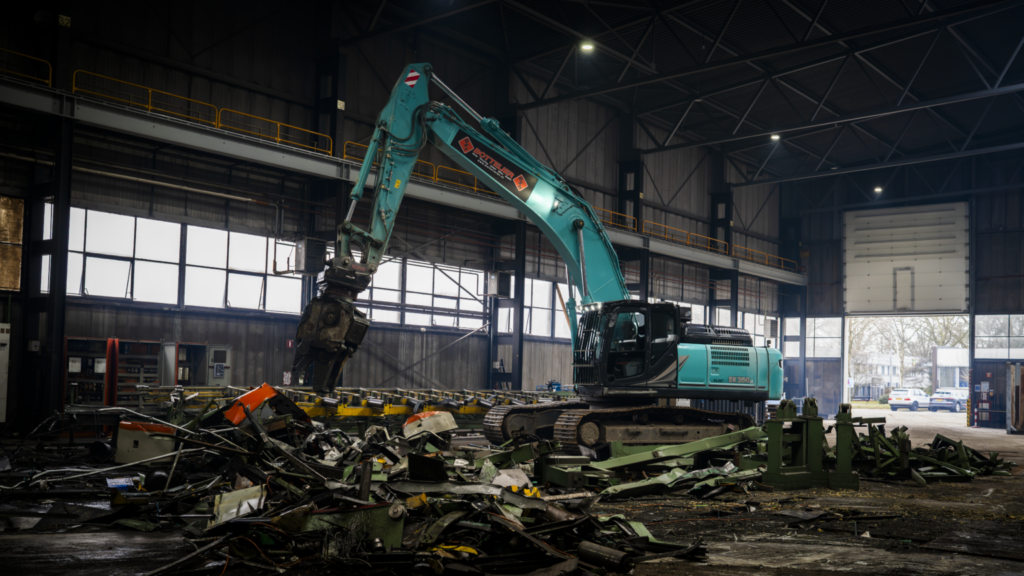
You plan the dismantling of a production facility by splitting the project into distinct phases: from inventory and permit applications to cleaning, dismantling, asbestos removal, and final delivery. A structured approach prevents delays, limits risks to people and the environment, and ensures that the production process is disrupted as little as possible. In this article, we answer the most frequently asked questions about planning an industrial demolition project.
Which phases does a professional dismantling project comprise?
A professional dismantling project of a production facility typically goes through six consecutive phases: inventory and risk analysis, permit applications, cleaning of installations, dismantling, demolition or removal, and finally the documented final handover of the site. Each phase builds upon the previous one and requires specialized knowledge.
The inventory phase lays the foundation for the entire project. During this phase, your demolition contractor maps out the materials present, hazardous substances such as asbestos or chromium-6, and the condition of the installations. Based on this, you draw up a plan of action that takes into account safety, environmental legislation, and the production process schedule.
The cleaning phase requires special attention for industrial facilities. After shutting down installations, harmful residues may remain in pipes, tanks, and equipment. The actual dismantling of the factory begin once the installations have been safely cleaned. This is followed by the demolition phase, after which the site is handed over ready for construction.
When should you start planning a demolition project?
It is best to start planning an industrial demolition project at least six to twelve months before the scheduled start date. The more complex the installations and the greater the risk of hazardous substances, the more preparation time you need. For large-scale projects, such as demolishing an entire factory or power plant, the preparation time can sometimes extend to two years.
The reason for this long lead time is multifaceted. Permit processes at municipalities and environmental agencies take time, especially when environmentally sensitive locations or asbestos-containing materials are involved. In addition, drawing up a detailed plan of action, including a safety plan and risk analysis, takes several months.
Starting the planning early also gives you the flexibility to properly phase the dismantling in relation to your company's operational planning. This prevents demolition work from coinciding with critical production moments.
How do you carry out demolition work without disrupting the production process?
Executing demolition work without disrupting the production process requires precise phasing, clear communication between the demolition contractor and the client, and the use of specialized techniques to limit vibrations, dust, and noise. This makes it possible to carry out dismantling and remediation work while other parts of the factory remain in operation.
In practice, this means that the demolition contractor draws up a detailed work schedule together with you. In this schedule, you specify which zones are in use simultaneously and which zones are cleared for demolition activities. Safety barriers, dust screens, and noise-reducing measures protect the active production environment.
Communication plays a major role in this. Daily coordination between the demolition contractor's project leader and your operations manager ensures that unexpected situations are resolved quickly without production coming to a standstill. A specialized contractor with experience in active industrial environments recognizes these risks and anticipates them proactively.
Which permits and certifications are required for industrial demolition?
Multiple permits and certifications are required for the industrial demolition and dismantling of a production facility. The exact requirements depend on the nature of the installations, the presence of hazardous substances, and the location. Mandatory elements typically include a demolition notification or environmental permit, an asbestos inventory report, and certified asbestos removal in accordance with process certificate SC 530.
For the demolition notification, you must submit it to the competent authority at least four weeks before the start of the work. If it concerns a large-scale demolition or an environmentally sensitive location, a full environmental permit is required, which significantly prolongs the process.
Relevant certifications for the demolition contractor themselves include:
- BRL SVMS-007 for the safe disposal of hazardous substances
- SC 530 for certified asbestos removal
- ISO 14001 for environmental management systems
- NEN-EN-ISO 9001 for quality management
- VCA Petrochemicals for work in the (petro)chemical industry
- SIKB 7000 for soil remediation and earthworks
When selecting a demolition contractor, always check whether these certifications are up to date. An insufficiently certified contractor can halt your project and hold you liable for violations of environmental and safety legislation.
How is released demolition material processed in a circular manner?
Demolition material released during the dismantling of a production facility is processed circularly by sorting, cleaning, and reusing it as much as possible. Steel, concrete, copper, and other metals are highly reusable. Materials that cannot be directly reused go to certified recycling streams. A professional demolition contractor strives for a reuse rate as close to 100 percent as possible.
Circular demolition begins as early as the planning phase. By inventorying in advance which materials and installations can be reused, marketed, or relocated, you significantly reduce the amount of residual waste. Complete production lines or valuable equipment can be dismantled and made available to other parties, preventing scrapping.
The processing of hazardous materials such as asbestos, chromium-6, or chemical residues requires a separate, strictly regulated processing route. These substances must never enter regular recycling streams and are disposed of by certified processors in accordance with applicable environmental legislation.
How do you choose the right demolition contractor for a complex production facility?
You select the right demolition contractor for a complex production facility based on four criteria: demonstrable experience with similar industrial projects, broad and up-to-date certification, the capacity to work on a turnkey basis from advice to final delivery, and a proven approach to carrying out work in active production environments.
During the selection process, always request reference projects from the same sector, such as the (petro)chemical, food, or energy industries. A contractor with experience only in building demolition is not necessarily suitable for dismantling a chemical plant. The complexity of industrial decommissioning projects requires specific knowledge of cleaning procedures, hazardous substances, and working in explosive atmospheres.
Assessment criteria you can include in your selection:
- Which certifications does the contractor hold, and are they up-to-date?
- Can the contractor handle the entire project turnkey, including permit applications?
- Does the contractor have experience working at active industrial sites?
- How does the contractor handle the circular processing of demolition material?
- What is the reuse rate achieved by the contractor?
- How is communication organized during the project?
How we help with the dismantling of your production facility
We guide industrial clients through the entire decommissioning process, from the initial survey to the site-ready handover. Whether it concerns a chemical plant, a complete production plant, or a power plant, we provide a turnkey solution. In concrete terms, this means:
- Drafting a customized action plan, safety plan, and risk analysis
- Handling all permit applications and documentation
- Cleaning of installations and safe removal of hazardous substances such as asbestos and chromium-6
- Dismantling of complete production lines and equipment, including marketing for reuse
- Execution of demolition work while your production process continues
- Circular processing of demolition material with a reuse rate of 99 percent
- Documented final delivery of the site
We hold certifications such as VCA Petrochemicals, ISO 14001, NEN-EN-ISO 9001, SC 530, and the CSR Performance Ladder Level 3, and have been working for decades in sectors such as the (petro)chemical, pharmaceutical, food, and energy industries. Would you like to know how we approach your decommissioning project? Contact us for a no-obligation consultation.