
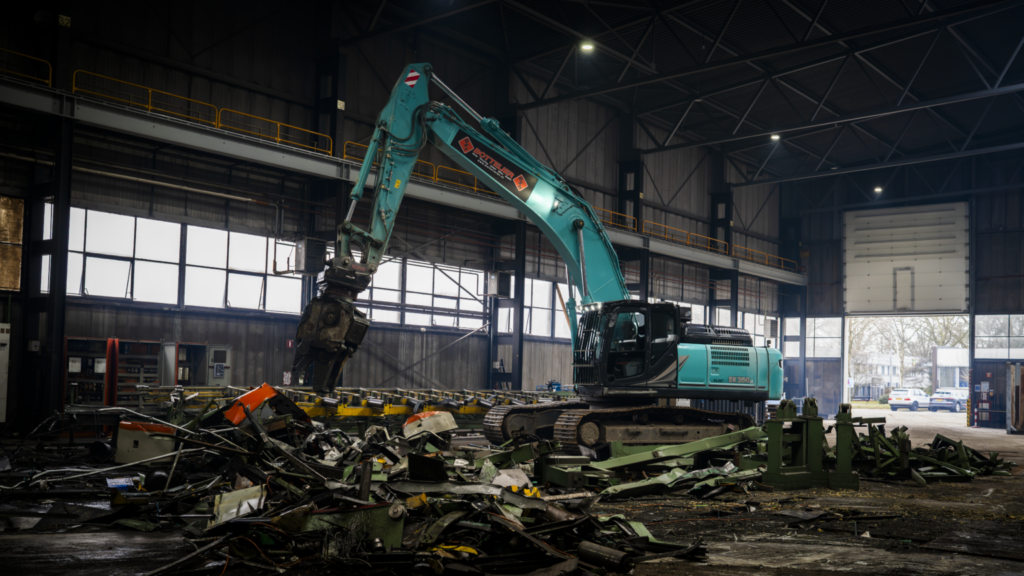
The dismantling of a production facility takes on average between three months and two years, depending on the size, complexity, and the presence of hazardous substances such as asbestos. Large industrial complexes in the petrochemical or energy sector typically require more time than smaller production lines. In this article, we answer the most frequently asked questions regarding lead times, preparation, and planning of industrial dismantling projects.
Which factors determine the lead time of a dismantling?
The lead time for the dismantling of a production facility is determined by a combination of project scope, the presence of hazardous substances, the condition of the installations, and the required permits. Each of these factors can significantly influence the schedule and requires careful prior analysis.
The most important factors influencing the lead time of an industrial demolition are:
- Size and complexity of the installation: A complete factory with multiple production lines requires more time than a single installation or production line.
- Presence of hazardous substances: Asbestos, chromium-6, or chemical residues require specialized remediation, which extends the schedule.
- State of the documentation: Well-maintained technical drawings and as-built documentation significantly speed up the preparation.
- Permitting process: Depending on the type of project and the location, permitting procedures can take weeks to months.
- Site availability: Working on a facility in use places additional demands on planning and phasing.
- Reuse objectives: When materials and installations are dismantled for reuse, this requires more care and therefore more time than demolition.
A thorough inventory and risk analysis at the start of the project form the basis for a realistic timeline. The more complete the picture beforehand, the better the planning aligns with reality.
How much time does the preparation before the demolition work take?
The preparation phase of an industrial dismantling project lasts on average four to twelve weeks. This phase includes, among other things, the inventory of hazardous substances, the drafting of a plan of action, permit applications, and the development of safety plans and risk analyses. For complex projects, this phase may take longer.
Good preparation is not a waste of time, but a time saver. Projects with incomplete preparation almost always experience delays once execution begins. Consider unexpected asbestos discoveries, missing permits, or uncertainty regarding the condition of installations.
During the preparation, the following steps are typically followed:
- Inventory of hazardous substances (including asbestos survey)
- Technical inspection and condition assessment of installations
- Drafting an action plan and safety plan
- Submitting and obtaining the necessary demolition permits and environmental permits
- Coordination with the client regarding phasing and continuity of the business process
- Cleaning of installations before dismantling, to remove hazardous residues
The cleaning of industrial installations deserves particular attention. After shutdown, toxic or harmful residues may remain in pipes, tanks, and reactors. This requires specific procedures to protect people and the environment before the actual industrial decommissioning begins.
How long does asbestos removal take during an industrial dismantling?
Asbestos remediation during an industrial dismantling takes on average from a few weeks to several months, depending on the quantity and type of asbestos. Risk Class 2 and 3 remediations, involving the release of bonded or non-bonded asbestos, require a certified approach with strict control measures and are more time-consuming than smaller remediations.
In industrial environments such as the petrochemical industry, energy sector, or heavy manufacturing, asbestos is often present in insulation material, gaskets, fire-resistant cladding, and roofing sheets. The scope of the remediation depends heavily on the construction period of the facility and the extent to which asbestos has already been inventoried or removed.
Factors that influence the duration of asbestos remediation are:
- The quantity and type of asbestos-containing material (bonded versus non-bonded)
- The accessibility of the locations to be remediated within the installation
- The risk class of the remediation and the associated certification requirements
- The need to construct separate containment areas
- The processing and disposal capacity of certified processors
It is important that asbestos removal is fully completed before adjacent demolition work begins. Simultaneous work is only possible with strict zoning and additional safety measures.
Can dismantling take place while production continues?
Yes, dismantling can take place while production continues elsewhere on the site, provided the project is carefully phased and the safety of personnel and operational installations remains guaranteed. This requires a detailed phase plan, clear zoning, and close coordination with the client.
For industrial clients, the continuity of the production process is often a strict prerequisite. Shutting down an entire factory is not always possible or desirable. Phased dismantling, in which a part of the facility is taken out of service at a time while the rest remains operational, is a widely used approach in practice.
Points of attention regarding simultaneous production and dismantling are:
- Strict physical separation between demolition zone and production environment
- Agreements regarding working hours and access to minimize disruption
- Specific safety protocols for working near active installations
- Regular coordination with the production department regarding progress and planning
- Additional requirements from the environmental permit for work at active sites
This working method places high demands on the executing party. Experience with complex industrial environments and the appropriate certifications, such as VCA Petrochemistry and SC 530, are not a luxury but a necessary condition.
What is a realistic timeline for major industrial demolition projects?
For large industrial demolition projects, such as the dismantling of a complete factory, power plant, or chemical plant, a total lead time of six months to two years is realistic. The exact timeline varies by project, but a general phasing provides a good idea of what to expect when planning a decommissioning project.
An indicative timeline for a large-scale industrial decommissioning project looks as follows:
- Months 1 to 3: Inventory, risk analysis, action plan, and permit applications
- Months 2 to 4: Cleaning of installations and removal of hazardous substances
- Months 3 to 6: Asbestos removal and other environmental remediation
- Months 4 to 12: Dismantling of installations, production lines, and buildings
- Months 8 to 18: Demolition work and removal of foundations
- Months 12 to 24: Soil remediation, site paving, and delivery ready for construction.
The lead time for the demolition itself is therefore only one part of the overall process. Delivering an industrial site ready for construction, including soil remediation and documentation, significantly extends the total project duration. Those who factor this into the planning beforehand avoid surprises at the end of the project.
How we help you plan a decommissioning project
Establishing a realistic timeline for the dismantling of a production facility requires technical knowledge, project experience, and insight into laws and regulations. We handle the entire process, from the initial survey to the documented handover of the site.
What we arrange for you:
- Complete inventory of hazardous substances, including asbestos and chromium-6
- Drafting a customized action plan, safety plan, and risk analysis
- Permit applications and coordination with competent authorities
- Cleaning, dismantling, asbestos removal, and demolition as an integrated turnkey package
- Reuse of materials with a reuse rate of 99%, minimizing the environmental impact
- Soil remediation and preparation of the site for construction
We work with the broadest certifications in the market, including ISO 14001, NEN-EN-ISO 9001, VCA Petrochemistry, and SC 530, and have decades of experience with complex industrial decommissioning projects in the petrochemical, energy, pharmaceutical, and heavy industry sectors. Would you like to know what a realistic timeline is for your project? Contact us for a no-obligation consultation.