
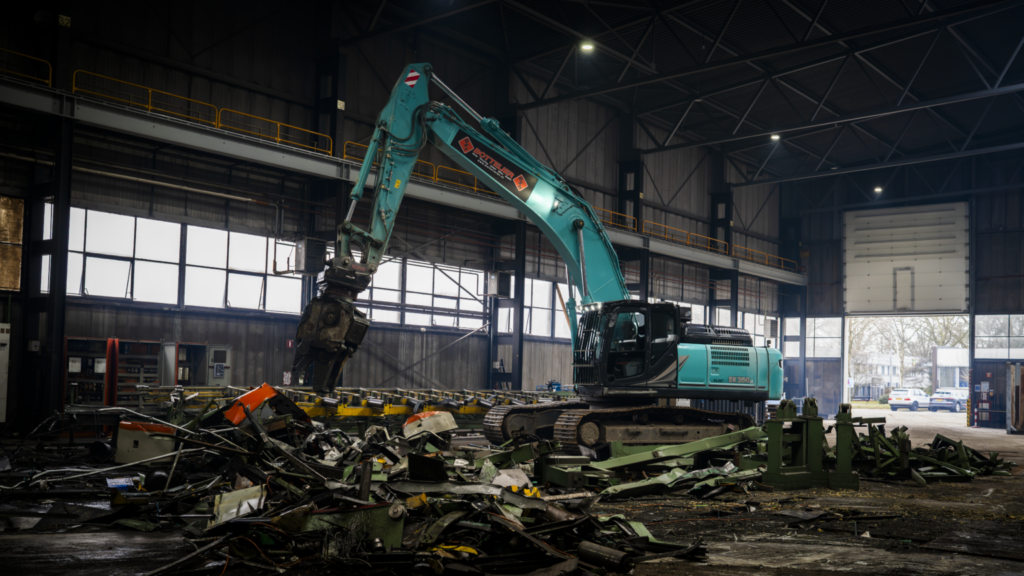
The greatest risks during the dismantling of production facilities are hazardous substances such as asbestos and chemical residues, structural failure of outdated structures, and legal liability resulting from insufficient compliance with environmental and safety legislation. These risks apply particularly to industrial environments where installations have been in use for years and where residues, corrosion, and complex structural situations converge. The questions below provide a concrete picture of the hazards involved and how to manage them.
Which hazardous substances are released during industrial dismantling?
During industrial decommissioning, multiple hazardous substances can be released, depending on the sector and the age of the installation. The most common are asbestos, chromium-6, process residues such as hydrocarbons and heavy metals, and chemical residues that remain in pipes, tanks, or equipment after shutdown. These substances pose a direct threat to the health of employees and the environment.
Asbestos remediation in industry is one of the most complex challenges when dismantling production facilities. Until the 1990s, asbestos was widely used as insulation material in industrial buildings and installations. During demolition work, asbestos fibers can be released that cause lung diseases if inhaled. Chromium-6 is another risk that occurs particularly in paint layers on steel structures and piping in the chemical and petrochemical industries.
In addition to these solid substances, there are also volatile hazards. In the oil and gas, petrochemical, and food industries, installations often still contain residual gases, liquids, or organic compounds after shutdown. Without thorough cleaning of the installation before the dismantling of industrial installations begins, the risk of exposure or ignition is real. A structured cleaning procedure is therefore a prerequisite, not an option.
How significant is the safety risk involved in the demolition of active installations?
The safety risk associated with the dismantling of active or recently active installations is significantly greater than that of completely shut down facilities. Residual pressure in pipelines, residual heat in reactors, electromagnetic fields near transformers, and unforeseen chemical reactions upon exposure to air are concrete hazards that must be carefully assessed during every dismantling of production facilities.
A particular challenge arises when demolition work takes place while part of the factory or site remains in operation. This scenario occurs more often than expected: a production line is demolished while an adjacent line continues. In that case, demolition activities must be aligned with the production rhythm, barriers must be installed, and risks must be reassessed at each stage.
Safety during demolition work stands or falls with a detailed safety plan tailored to the specific installation. This plan describes, among other things, work zones, personal protective equipment, communication procedures in the event of emergencies, and the dismantling sequence. Without this plan, the risk of accidents increases significantly, even if individual employees are experienced.
What are the legal and environmental risks of decommissioning?
The legal and environmental risks associated with industrial decommissioning are significant when permits are missing, legislation is not properly complied with, or hazardous waste is not disposed of correctly. Clients can be held liable for soil contamination, illegal asbestos removal, or violations of the Environmental Management Act, even when they have outsourced the execution to a third party.
Dutch legislation and regulations regarding demolition and remediation are strict. Specific certification requirements apply to the executing party for asbestos removal, and a demolition notification or environmental permit is mandatory for demolition work of a certain scale. In the case of soil contamination, additional obligations apply under the Soil Quality Decree and the Soil Protection Act.
A common mistake is that clients assume full legal responsibility lies with the contractor. In practice, the site owner remains jointly responsible for compliance with environmental legislation. It is therefore important to make clear contractual agreements at the start of a project regarding who applies for which permits and who is responsible for documented delivery.
What structural risks are involved in the demolition of outdated buildings?
Structural risks are significant during the demolition of outdated industrial buildings. Corrosion, weakened foundations, unexpected structural connections, and a lack of up-to-date construction drawings make it difficult to predict a building's stability during demolition work. This applies particularly to buildings that have been exposed to chemical stress or moisture for decades.
Corrosion and material aging
Steel structures in industrial environments are susceptible to corrosion, especially when exposed to aggressive process conditions. Corrosion affects the load-bearing capacity of structures in a way that is not always visible from the outside. During the dismantling of industrial installations, a load-bearing beam or column may suddenly collapse at the moment of cutting if the remaining load-bearing capacity is too low.
Missing or outdated documentation
Many industrial buildings currently being demolished were constructed at a time when documentation was maintained in a less structured manner. Construction drawings are outdated, modified without registration, or simply no longer available. This makes a prior structural inspection and risk analysis per building component necessary before demolition work begins.
How are demolition risks managed in practice?
Demolition risks in industrial dismantling are managed through a combination of thorough preparation, certified execution, and step-by-step risk management per project phase. A solid inventory of hazardous substances, a tailored safety plan, and clear communication between client and contractor form the basis of a safely and legally compliant demolition project.
In practice, risk management begins in the preliminary phase: a comprehensive asbestos inventory, a structural inspection, and an environmental investigation into the soil and the materials present. Based on this, the contractor draws up a risk analysis that determines which measures are required for each phase. Work only commences once this plan has been approved and the necessary permits have been granted.
During execution, risk management is ensured through certified employees, periodic inspections, and a clear phasing of the demolition work. In complex projects where installations in production border the demolition zone, continuous coordination with the client is indispensable for the safety of both the demolition team and the operational personnel.
How Bottelier helps with the safe dismantling of production facilities
We guide industrial clients through the entire decommissioning process: from the initial risk analysis and permit applications to the documented, construction-ready handover of the site. Our approach is turnkey, which means that as a client, you have a single point of contact for all activities.
What we specifically do for you:
- Performing asbestos surveys and asbestos remediation in accordance with all legal requirements
- Cleaning installations before dismantling to prevent exposure to hazardous residues
- Drafting customized safety plans and risk analyses per project
- Dismantling of complete production lines and installations, including at adjacent facilities that are in operation
- Managing all permit processes and ensuring documented delivery
- Achieving a reuse rate of 99% for released materials
We hold certifications such as VCA Petrochemicals, ISO 14001, NEN-EN-ISO 9001, SC 530, and CSR Performance Ladder Level 3, ensuring that the execution meets the strictest safety and environmental standards. Would you like to know how we approach your decommissioning project? Contact us for a no-obligation consultation.