
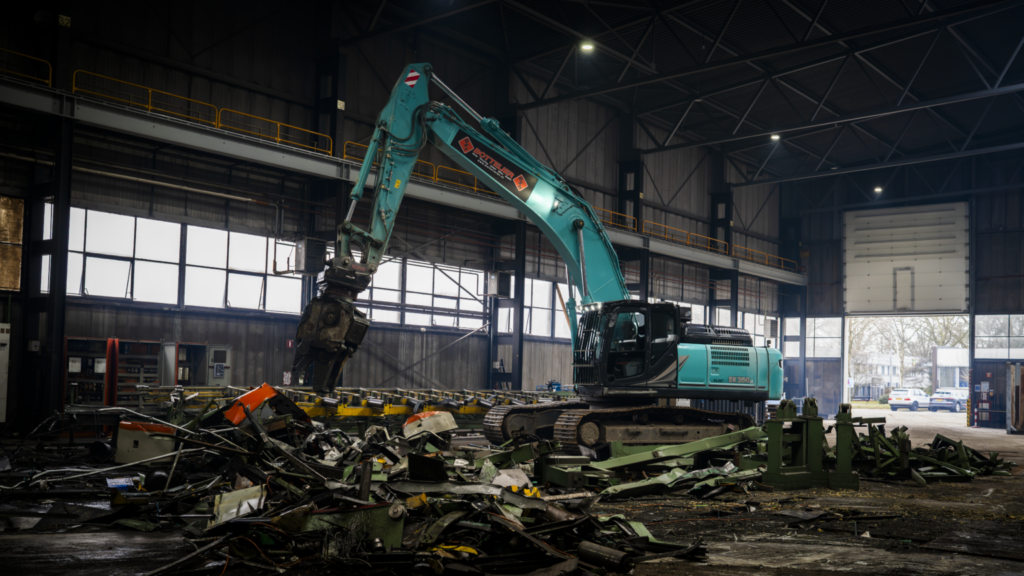
A decommissioning audit is a systematic examination of an industrial asset in which you map out the technical condition, materials present, hazardous substances, and reusable components prior to demolition or dismantling. You conduct this audit as soon as an installation, factory, or building is taken out of service and you need a substantiated basis for the demolition specifications, permit applications, and safety planning. The questions below cover everything you need to know about conducting a decommissioning audit of industrial assets.
What information does a decommissioning audit provide?
A decommissioning audit provides a detailed overview of the composition, condition, and risks of an object to be demolished or dismantled. You gain insight into the presence of hazardous substances, the quantity and quality of released materials, the technical complexity of the dismantling, and the preconditions for safe execution.
Specifically, the audit maps out the following information:
- Presence and location of hazardous substances such as asbestos, chromium-6, PCBs, and process residues
- Quantities and types of released material flows such as steel, concrete, copper, and plastic
- Reusable installations, machines, or parts eligible for remarketing or relocation
- Technical risks such as instability, residual pressure in pipelines, or contamination of equipment
- Environmental and safety preconditions that determine the implementation schedule
For industrial facilities, the audit report forms the basis for the demolition specifications, the risk analysis, and the safety plan. The more complex the installation, the greater the value of a thorough audit for the cost estimation and planning of industrial dismantling.
When is a dismantling audit mandatory?
A demolition audit is legally required when you wish to demolish a structure or industrial object for which an environmental permit for demolition is required. Pursuant to the Buildings and Living Environment Decree (Bbl), you must submit a demolition safety plan and an inventory of hazardous substances with the permit application, for which the audit forms the basis.
In addition to the statutory obligation, a decommissioning audit is also functionally mandatory in the following situations:
- In the presence of asbestos or other hazardous substances, where a certified survey is legally required before demolition work commences
- In complex industrial installations in the (petro)chemical, energy, or process industries, where process residues and toxic substances pose an additional risk
- In projects where the reuse or remarketing of installations and materials is a contractual requirement
- For assignments for government bodies or listed companies that require demonstrable compliance with environmental and safety legislation
Always conduct the audit before applying for permits, so that the report is available in time for project preparation.
How does a dismantling audit differ from an asbestos survey?
An asbestos inventory focuses exclusively on detecting and documenting materials suspected of containing asbestos within a property. A decommissioning audit has a broader scope: it encompasses all hazardous substances, the technical condition of the installation, released material flows, and the execution preconditions for complete decommissioning.
The main difference lies in the purpose. The asbestos inventory is a specific legally required document drawn up by a certified inspector in accordance with the SC 540 process certificate. The outcome determines how asbestos must be removed. The decommissioning audit is an integral project document that describes the complete technical and environmental condition of the object and serves as the basis for the demolition specifications and the tender.
In practice, the asbestos inventory forms part of the broader decommissioning audit for industrial facilities. You can have the two surveys carried out jointly, but they are always reported separately because each has its own legal framework.
Who is authorized to conduct a dismantling audit?
A decommissioning audit may be carried out by a certified inspector or a specialized consultancy firm with demonstrable knowledge of demolition techniques, hazardous substances, and industrial installations. There is no single statutory certificate that specifically regulates the decommissioning audit, but the performer must comply with the requirements applicable to the sub-assessments within the audit.
Regarding the asbestos component, the inventory may only be carried out by a company holding the SC 540 process certificate. For the broader environmental and technical investigation, relevant qualifications such as ISO 14001 certification and knowledge of the Buildings and the Living Environment Decree are important.
For industrial facilities, it is advisable to choose a party that can oversee both the audit phase and the execution phase. A demolition or dismantling company with its own audit capacity can translate the findings directly into a realistic plan of action, preventing errors in the handover between advice and execution.
What does a decommissioning audit cost for an industrial property?
The costs of a decommissioning audit at an industrial site vary widely and depend on the size of the site, the complexity of the installations, the number of hazardous substances to be investigated, and the amount of documentation already available to the client.
The following factors significantly determine the price:
- Scope of the object: a small production unit requires less research time than a complete factory or power plant.
- Presence of hazardous substances: extensive sampling and laboratory analyses increase costs
- Availability of as-built drawings: missing documentation leads to more fieldwork
- Required depth of reporting: a procurement audit requires more detail than a quick scan for budget formation.
Consider the audit costs as an investment that prevents unexpected additional costs during execution. A well-substantiated audit significantly reduces the risk of delays, additional remediation orders, and legal complications.
How do you use the audit results for a demolition specification?
The audit results form the direct basis for the demolition specifications: you translate the findings into work descriptions, safety measures, material flow plans, and execution sequences. Without a full audit, a reliable demolition specification cannot be drawn up, because you have insufficient knowledge of the risks and quantities.
Use the audit report in the following way when drafting the specifications:
- Remediation description: list the hazardous substances and their locations in separate specification items, with the corresponding removal method and disposal route.
- Material flow plan: link the inventoried material flows to reuse goals or processing routes, which substantiates the circular removal.
- Execution sequence: align the order of activities with the technical risks uncovered by the audit, such as residual pressure or instability.
- Safety plan: use the risk analysis from the audit as input for the Health and Safety plan and the task risk analyses.
- Permit application: submit the audit report as an attachment to the environmental permit for demolition.
A demolition specification directly derived from a thorough dismantling audit provides contractors with a clear basis for their bid and prevents disputes regarding additional work during execution.
How we help you with the decommissioning audit and execution
We guide industrial decommissioning projects from start to finish, including the audit phase. Our approach combines technical expertise with broad certification, so you have a single point of contact for the entire process.
What we take care of for you:
- Comprehensive dismantling audit including inventory of hazardous substances such as asbestos and chromium-6
- Translation of the audit results into a concrete plan of action and demolition specifications
- Permit applications and project management throughout the entire demolition process
- Execution of dismantling, cleaning, remediation, and demolition at installations in production without disruption of the business process
- Circular processing of released materials with a reuse rate of 99%
Would you like to know what a decommissioning audit means for your project? Contact us and we will discuss the possibilities for your specific situation.