
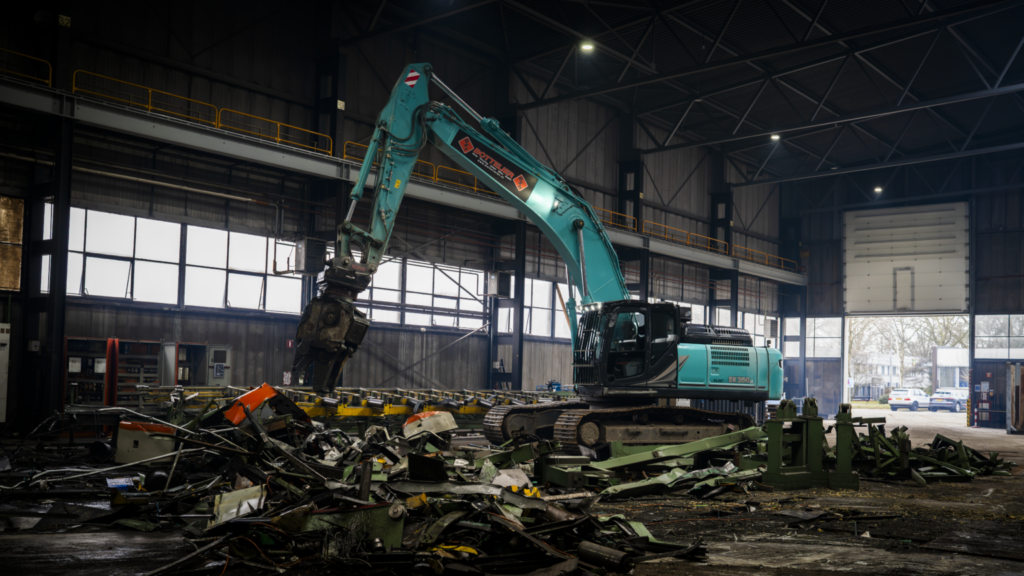
Circular dismantling of production facilities is a method in which installations, machinery, and buildings are systematically disassembled with the aim of maximizing the reuse or recycling of materials, rather than disposing of them as waste. This distinguishes it fundamentally from traditional demolition, where removal is the central focus. For industrial clients, this approach offers both environmental benefits and economic value from the released materials. In this article, we answer the most frequently asked questions about circular dismantling, from the difference compared to conventional demolition to the steps involved in a concrete project.
How does circular dismantling differ from traditional demolition?
In traditional demolition, the focus is on removing a structure as quickly and efficiently as possible, during which materials are often mixed and largely disposed of as waste. Circular dismantling reverses the order: first, valuable materials and components are carefully dismantled and sorted so that they are given a second life as a reusable product or raw material.
The difference lies not only in the execution but also in the preparation. Circular demolition begins with a material scan or demolition inventory, mapping out which components are reusable, which can be recycled, and which are disposed of as residual waste. Examples include steel structures that are dismantled and resold immediately, or process installations that are put back into use elsewhere. With sustainable demolition, the aim is to maintain the highest possible quality of the material flow, which means that reuse is always preferred over recycling, and recycling is preferred over incineration or landfilling.
Which materials are reused in the circular dismantling of factories?
The circular dismantling of production facilities generates diverse material flows suitable for reuse. The most valuable category is structural steel: beams, columns, and pipelines are dismantled, cleaned, and resold or deployed in other projects. The same applies to complete process installations, pumps, compressors, and heat exchangers.
In addition, the following material flows are released during factory dismantling and are processed in a circular manner:
- Non-ferrous metals such as copper, aluminium, and stainless steel, which have a high residual value on the commodities market
- Concrete rubble that is used as foundation material or aggregate after processing
- Insulation material that can be recycled, provided it is free of hazardous substances.
- Electrical components and cables that are dismantled and sorted for material recovery
- Process equipment that goes back into production elsewhere after cleaning and inspection
A reuse rate of 99% is achievable when the dismantling industry operates professionally and the logistics surrounding sorting and marketing are organized in advance. This requires specific knowledge of material flows and a network of buyers for second-hand industrial equipment.
How does a circular dismantling project proceed step by step?
A circular dismantling project follows a fixed phasing in which preparation is at least as important as the execution itself. The approach always begins with a thorough inventory and ends with a documented, construction-ready handover of the site.
The steps in a typical circular dismantling project are:
- Inventory and material scan: Mapping all present materials, hazardous substances (such as asbestos or chromium-6), and reusable components.
- Advice and plan of action: Drafting a customized demolition specification, safety plan, and risk analysis.
- Permit applications: Arranging all necessary environmental and demolition permits
- Cleaning of installations: Removal of hazardous residues from process installations before dismantling begins
- Remediation: Removal of asbestos or other hazardous materials in accordance with legal requirements
- Systematic dismantling: Phased dismantling of installations, structures, and buildings with priority for reusable parts
- Sorting and marketing: Released materials are sorted, assessed, and offered for reuse or recycling.
- Documented delivery: The site is delivered ready for construction with complete documentation of the work performed and material flows.
The industrial dismantling of complex production facilities requires a turnkey approach in which all disciplines, from cleaning and sanitation to dismantling and soil remediation, are coordinated by a single contractor. This prevents miscommunication between parties and monitors the progress of the project.
Can circular dismantling take place during ongoing production?
Yes, circular dismantling can take place while a factory or plant is still in operation, but this requires precise planning, strict safety protocols, and an experienced contractor familiar with working in active industrial environments. The dismantling is then carried out in phases so that the ongoing production process is not disrupted.
In practice, this means that work is scheduled outside peak hours, that clear separation is established between active and decommissioning zones, and that all activities are aligned with the client's operational schedule. Safety plans and risk analyses play a central role in this: for each phase, the existing risks are identified and how they are managed. For sectors such as the petrochemical, pharmaceutical, and food industries, this is a common situation where continuity of the production process is a strict prerequisite.
Which certifications are required for circular industrial dismantling?
Strict legal and normative requirements apply to the circular dismantling of industrial production facilities. A certified contractor holds at least a process certificate for asbestos removal (SC 530), but additional certifications are required for complex industrial projects.
Relevant certifications for sustainable demolition in the industry are:
- BRL SVMS-007 / SC 530: Mandatory for the removal of asbestos
- VCA Petrochemicals: Required for work in the (petro)chemical industry
- NEN-EN-ISO 9001: Quality management system for controllable project execution
- ISO 14001: Environmental management system that ensures demonstrably sustainable working practices
- CO2 Performance Ladder Level 3: Proof of active CO2 reduction in business operations
- CSR Performance Ladder Level 3: Certification for Corporate Social Responsibility
- SIKB 7000 protocol 7001/7004: Applicable to soil remediation as part of the dismantling project
For industrial clients, the breadth of certification is a reliable indicator of a contractor's quality and safety level. The more disciplines a contractor is certified to master, the lower the coordination risk in complex, multi-phase decommissioning projects.
What are the benefits of circular dismantling for industrial clients?
Circular dismantling offers industrial clients three concrete advantages over traditional demolition: lower net project costs due to the residual value of released materials, demonstrable compliance with environmental legislation, and a significant reduction in the project's CO2 footprint.
In concrete terms, this means the following for your project:
- Financial benefit: Reusable equipment and non-ferrous metals represent a real market value that can be deducted from the project costs.
- Compliance: Circular working aligns with increasing legislative requirements regarding waste prevention and material reuse within the EU.
- Sustainability reporting: The reuse rate and CO2 reduction are measurable and documentable, contributing to your own sustainability objectives and reporting.
- Reputation: Clients who opt for sustainable demolition demonstrate that corporate social responsibility also applies to the end of the life cycle of their installations.
- Reduced risk: A turnkey approach with a single contractor responsible for the entire process reduces coordination risks and accelerates turnaround time.
How we help with the circular dismantling of production facilities
For decades, we have been executing complex industrial decommissioning projects in sectors such as petrochemicals, pharmaceuticals, the food industry, and energy generation. Our approach is fully turnkey: from initial surveying and permit applications to the documented, construction-ready delivery of the site. This is specifically what we arrange for you:
- Material scan and demolition inventory including hazardous substances
- Cleaning and remediation of process installations for dismantling
- Phased dismantling with maximum reuse of materials and equipment
- Marketing of released materials and installations
- Complete documentation of material flows and documented delivery
- Execution during ongoing production, without disrupting your business process
Would you like to know what circular dismantling means for your production facility? Contact us for a no-obligation consultation.